QUADOA® Application Examples
These application examples show optical systems designed and analyzed in QUADOA® Optical CAD, from smartphone and camera lenses to AR/VR optics, head-up displays, microscopes, telescopes, interferometers and laser optics. Click an example for more details and a larger image.
Nothing found. Try another word, or show everything.
Browse by category
12 examples · Smartphone, wide-angle, fisheye, tele-photo, zoom and projection lenses, with ghost and image analysis. VR/AR
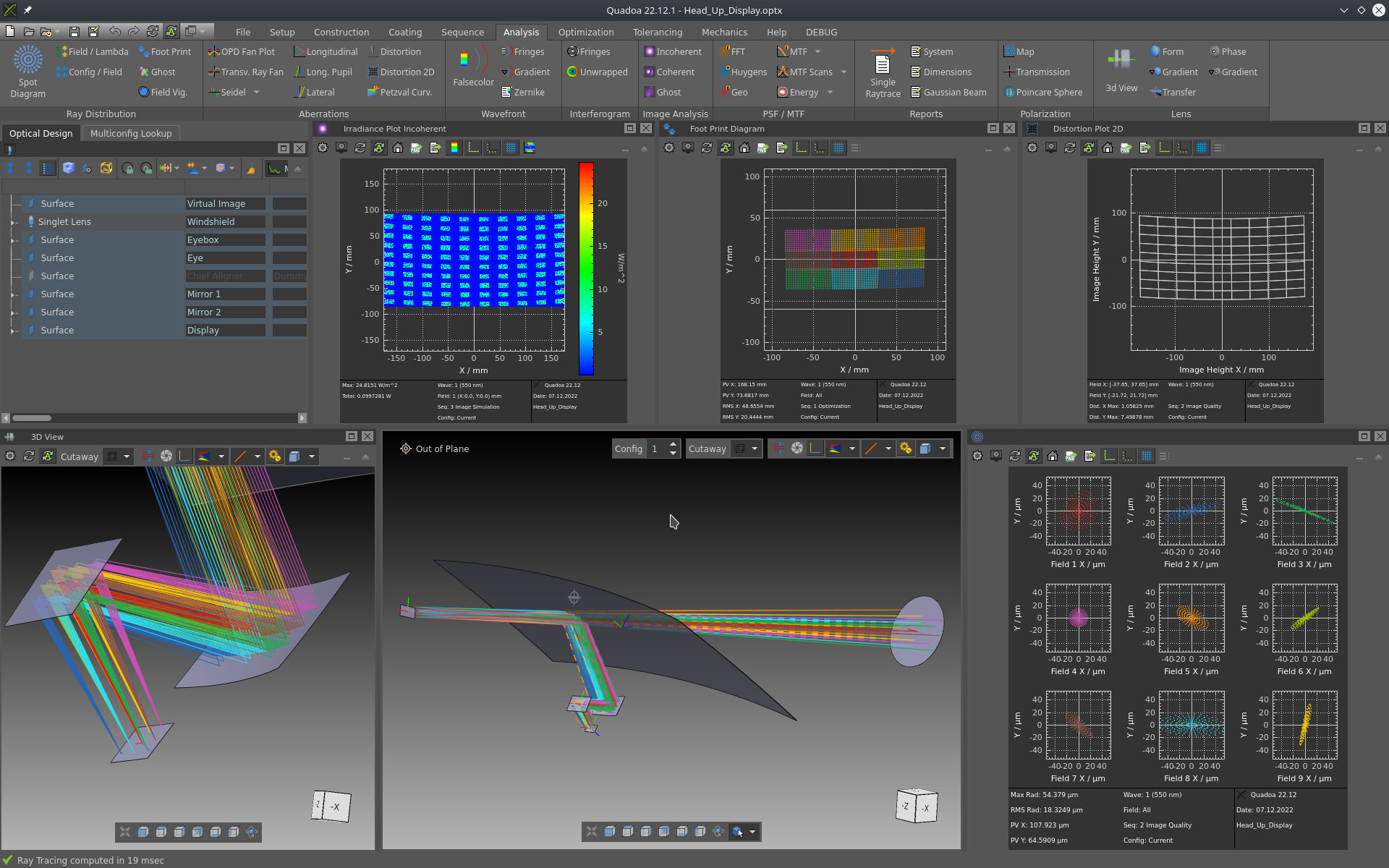
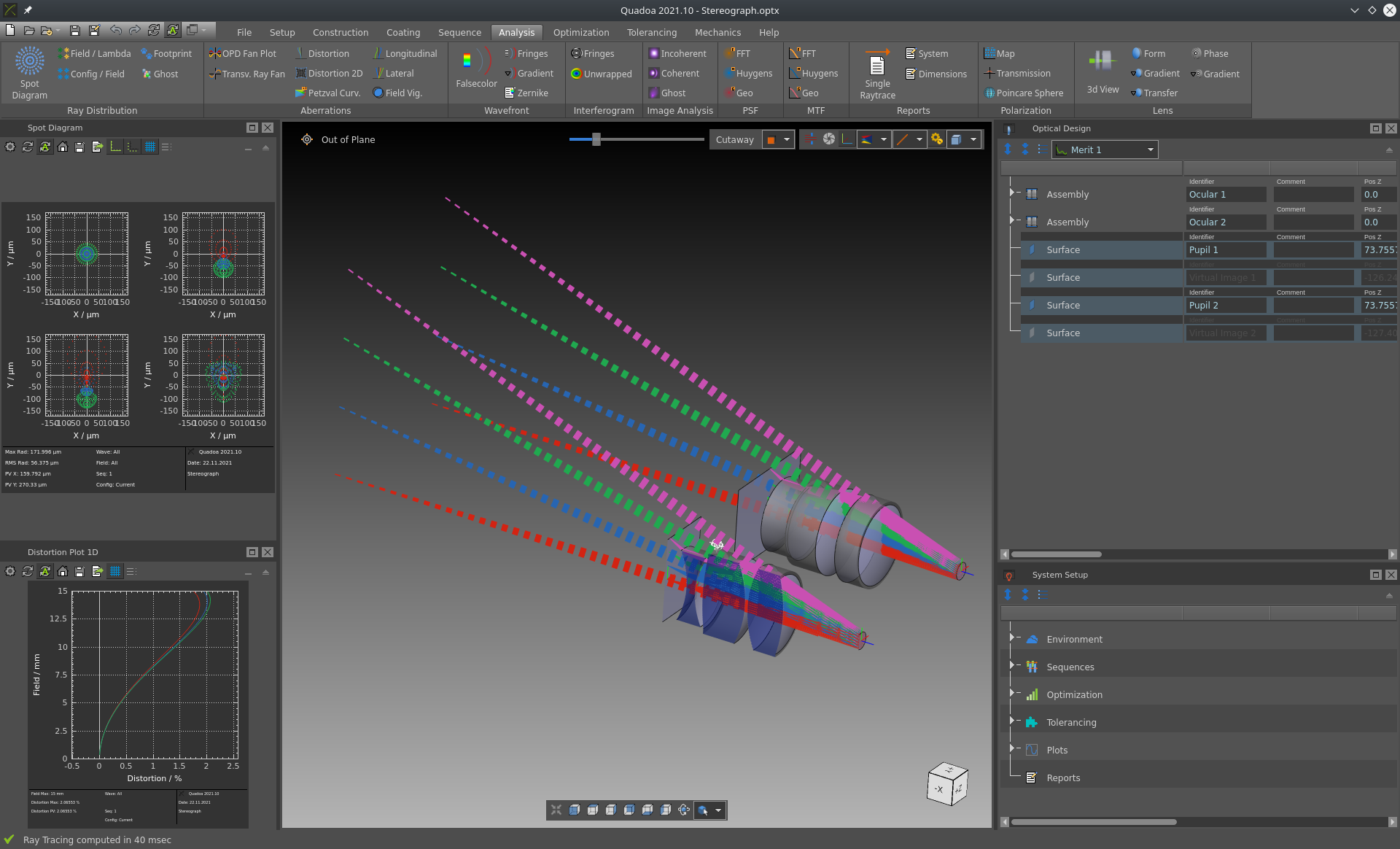
4 examples · Pancake lens, AR freeform prism, head-up display and stereograph eyepieces. Metrology / Sensors
5 examples · Fizeau and Mach-Zehnder interferometers, a grating spectrometer and a Herriott cell. Microscopy
4 examples · Microscope objectives, misalignment analysis, a mirror microscope and a stereo lens. Semiconductor / Lithography
4 examples · PCB inspection, laser beam combining, beam shaping and a computer-generated hologram. Telescopes / Space
6 examples · Mirror, off-axis and freeform telescopes, the JWST compound surface and telescope mechanics. Software features
12 examples · Examples that show a QUADOA® feature rather than one application: catalogs, surface forms, mechanics, polarization and scripting.
Model files: 23 examples come with a model file to download. Open them with the free 45-day QUADOA® trial.
Camera Lenses
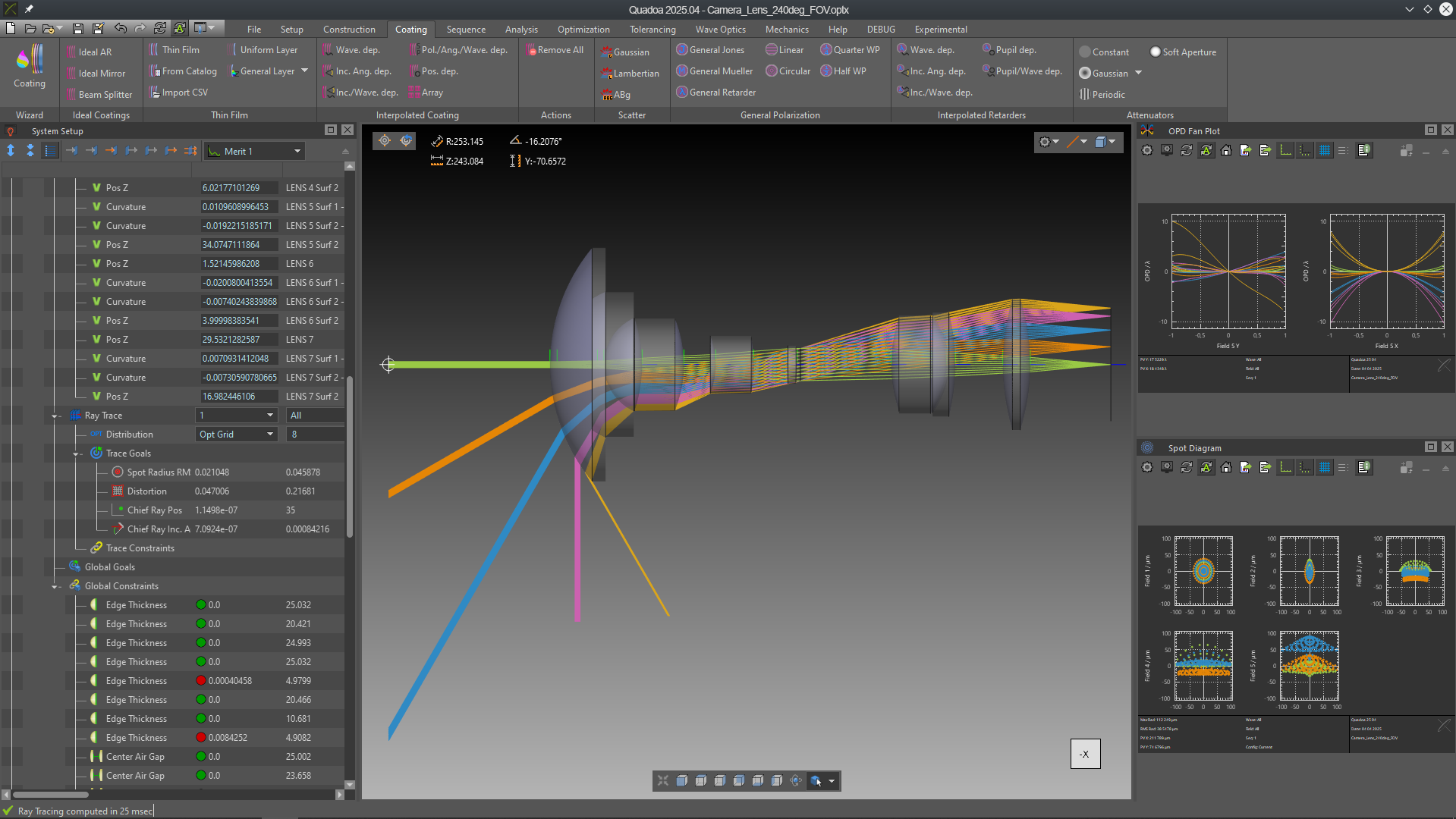
FOV 240 Wide Angle Camera Lens
This image shows a FOV 240° wide-angle camera lens, designed to capture an ultra-broad perspective.
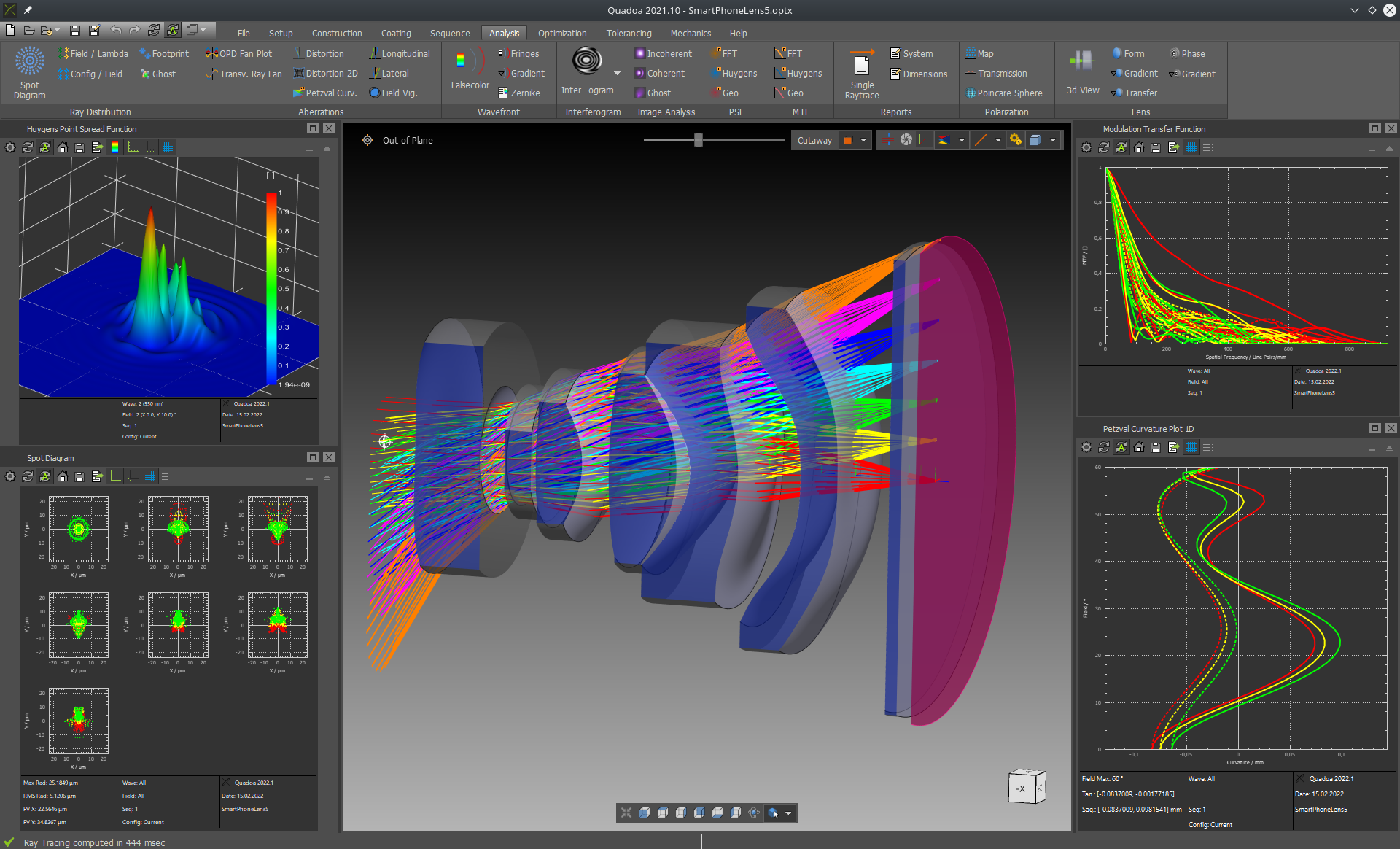
Smartphone Objective
Highly miniaturized optical system with steep aspheres for the application in smartphones.
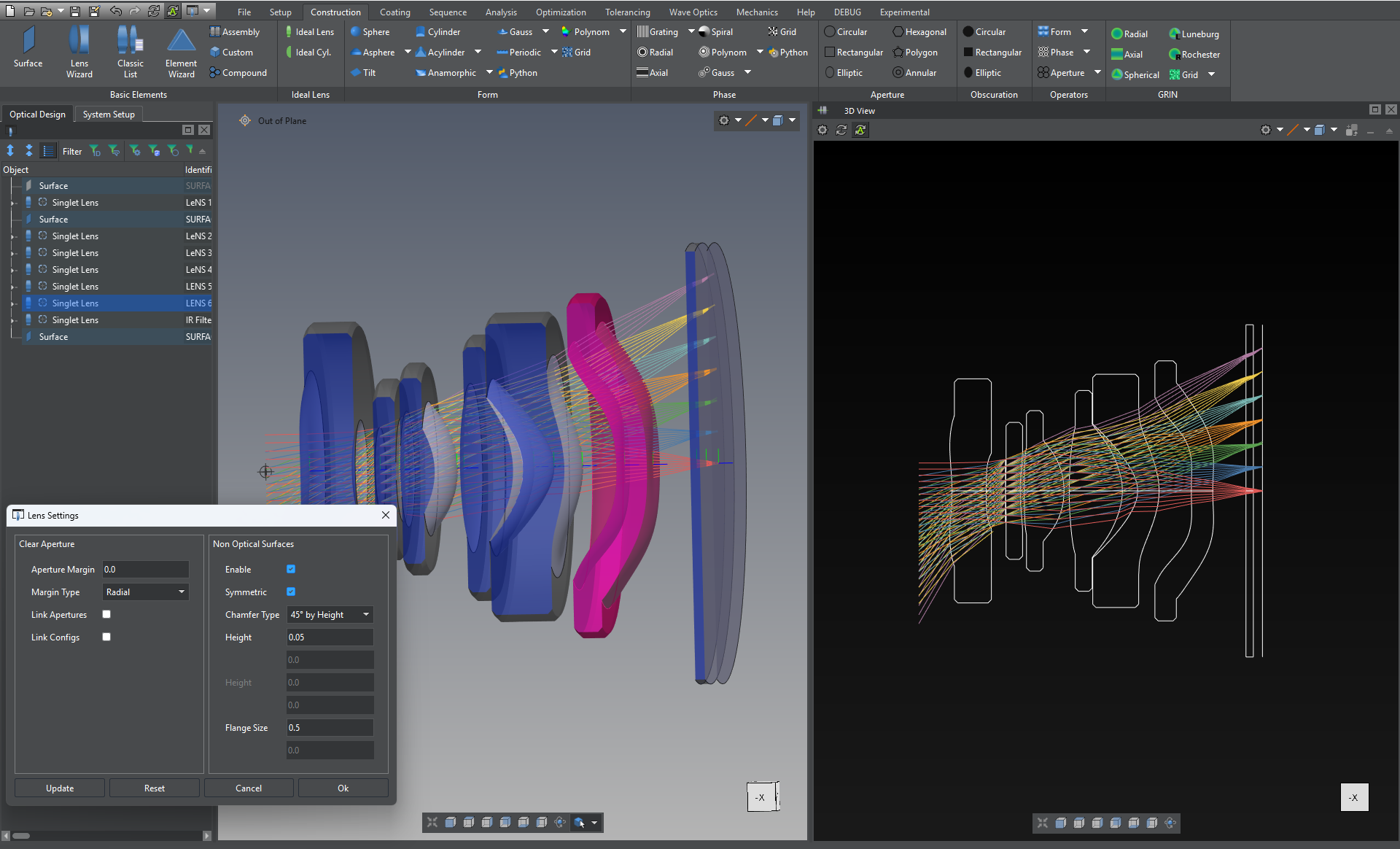
Chamfers and Flanges for Smartphone Lens
Smartphone camera lens with integrated mounting flanges and chamfers.
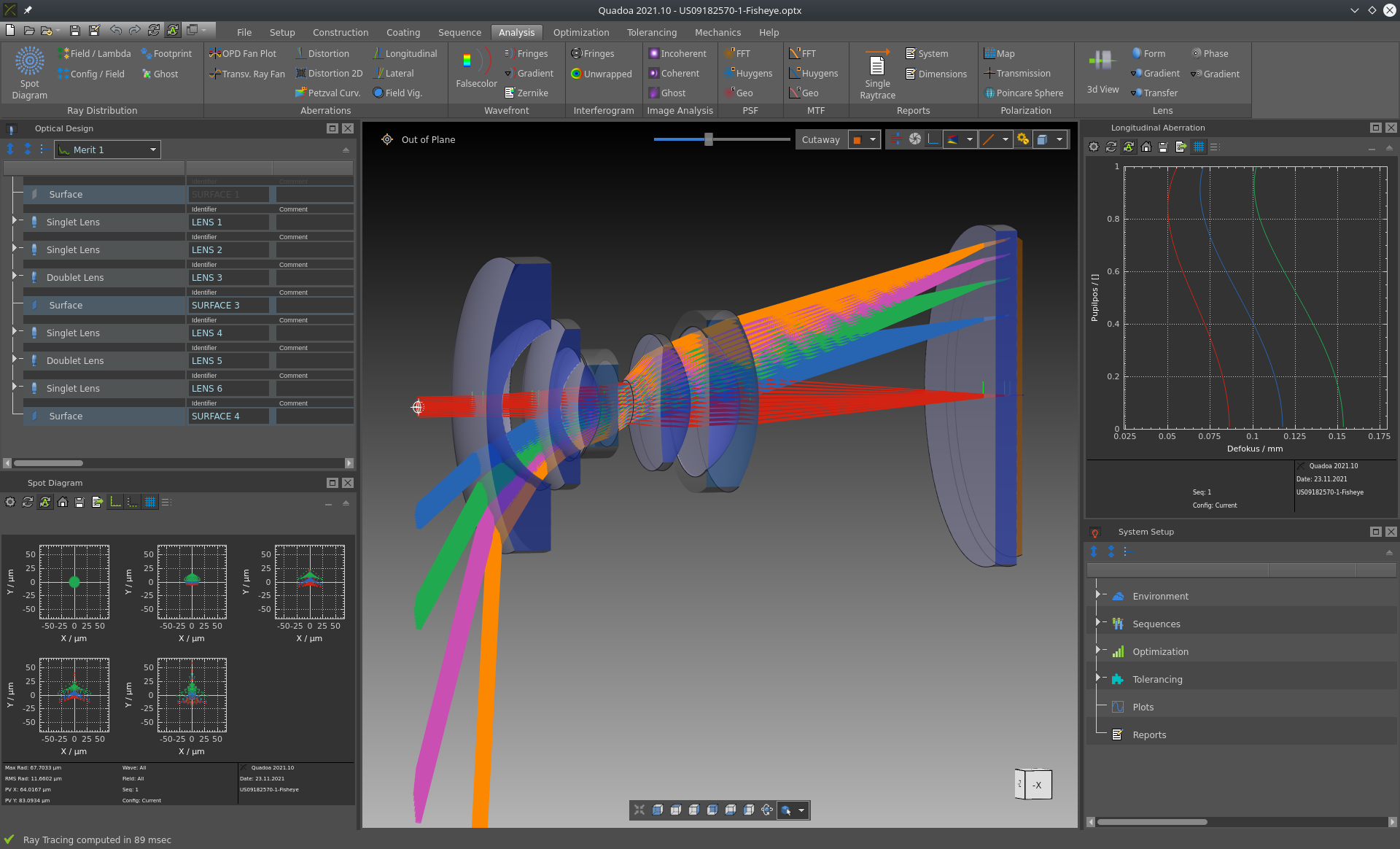
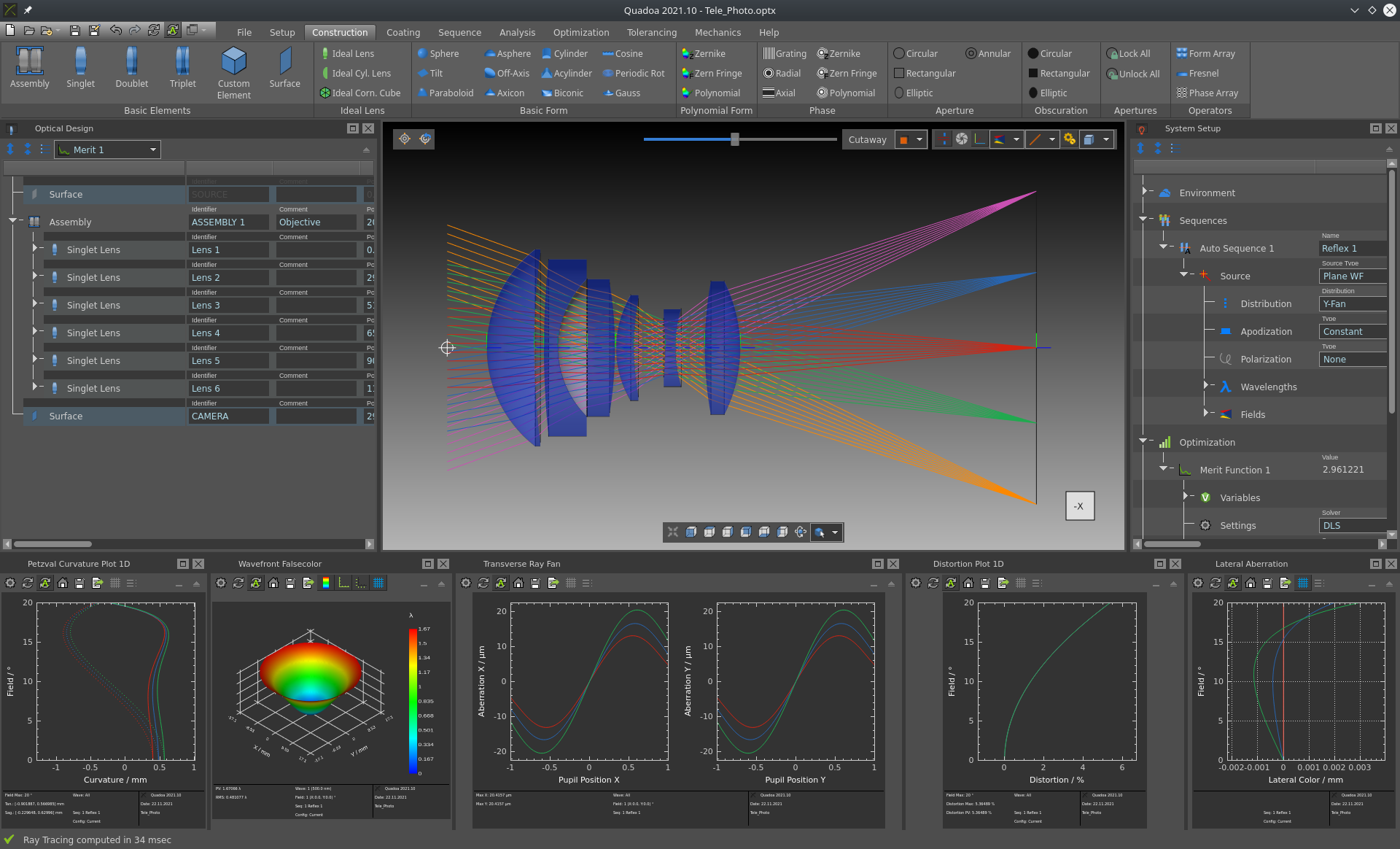
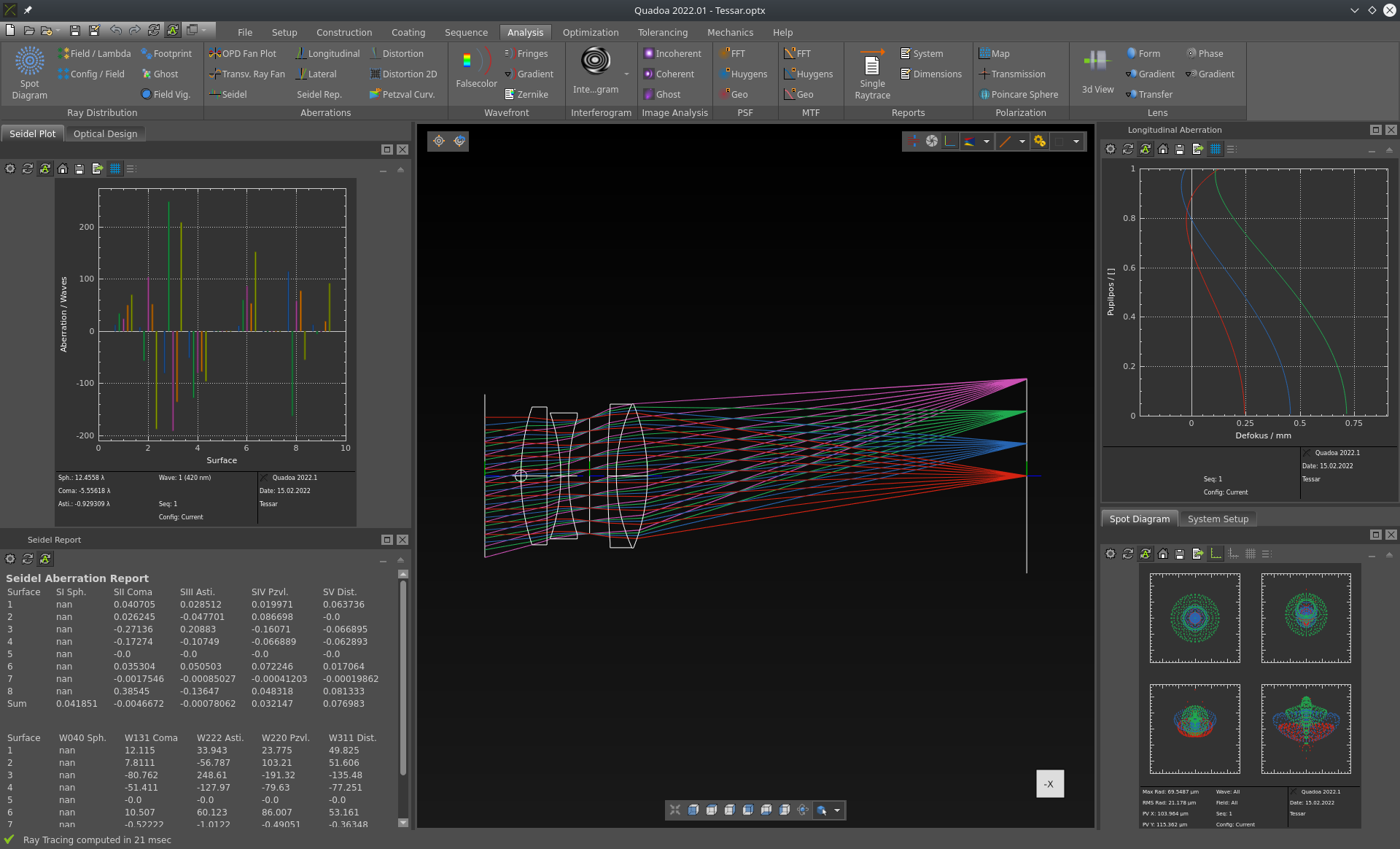
Tessar
Classical Tessar type camera lens with some analysis plots like Seidel and chromatic aberration analysis.
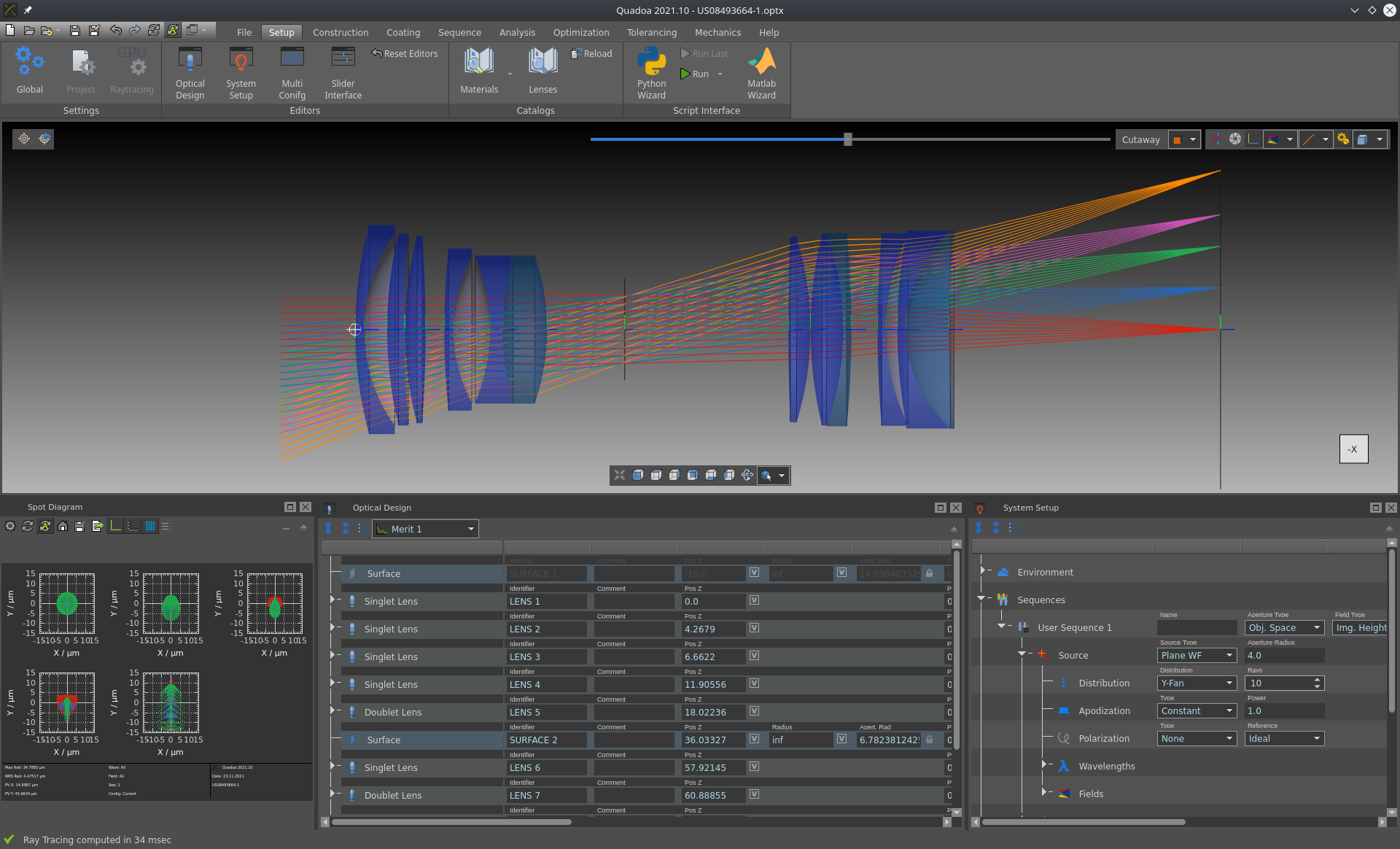
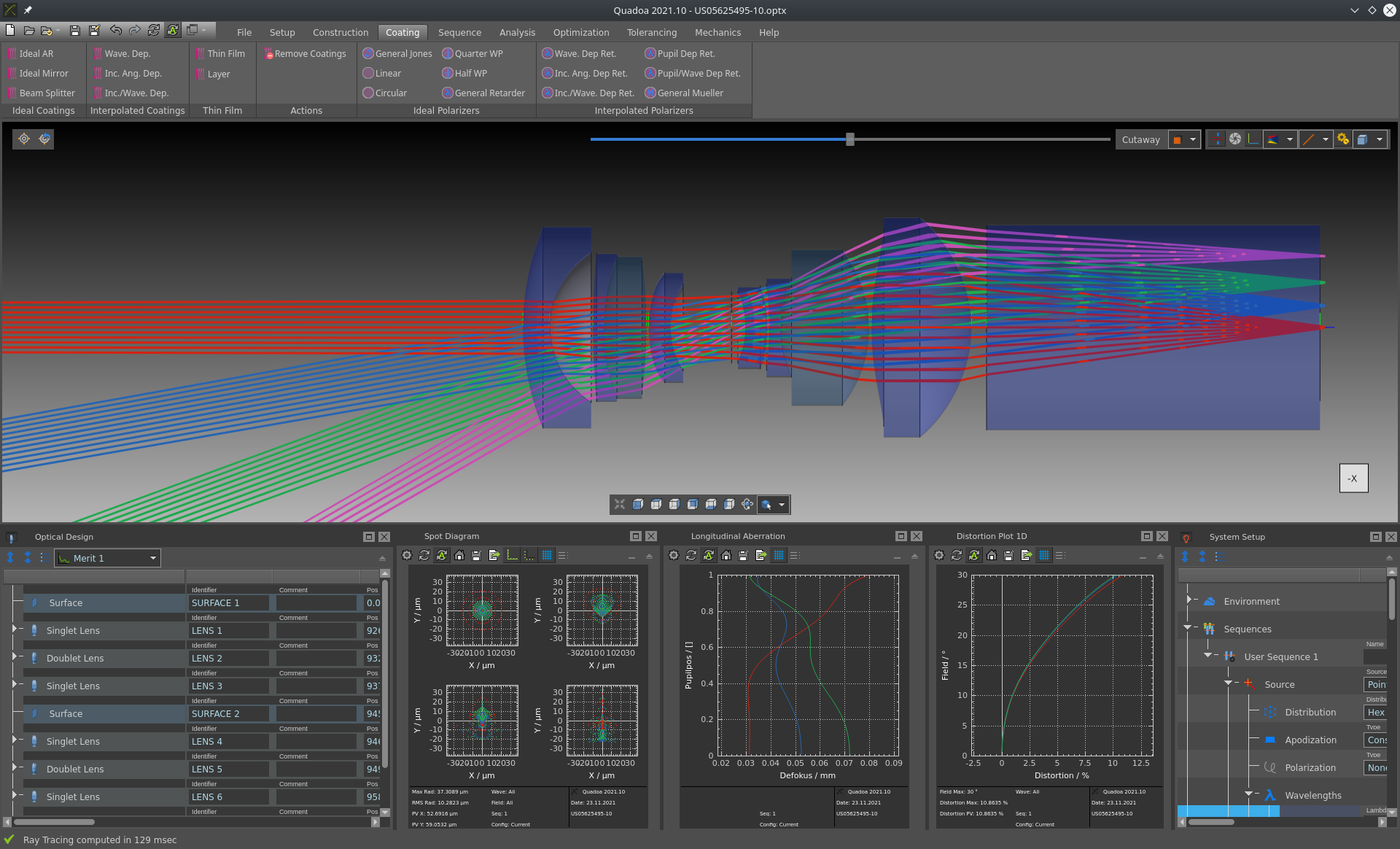
Projector
Cinematic projection lens with a large window serving as thermal isolator for the lightsource.
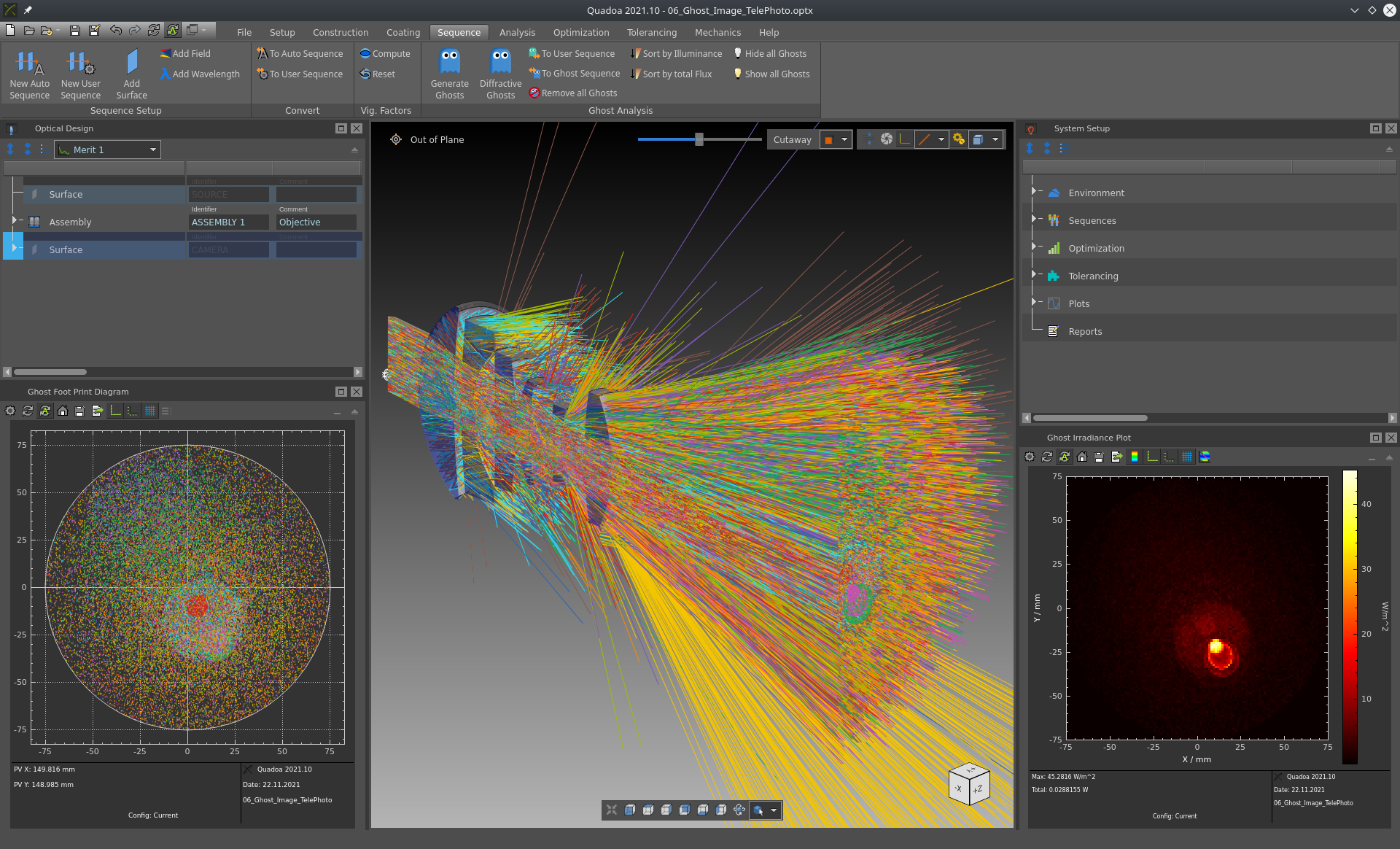
Integrated Live Ghost Analyzer
Sequential ghost reflex analysis performed on an imaging system to estimate and optimize the impact of the reflexes on the image quality.
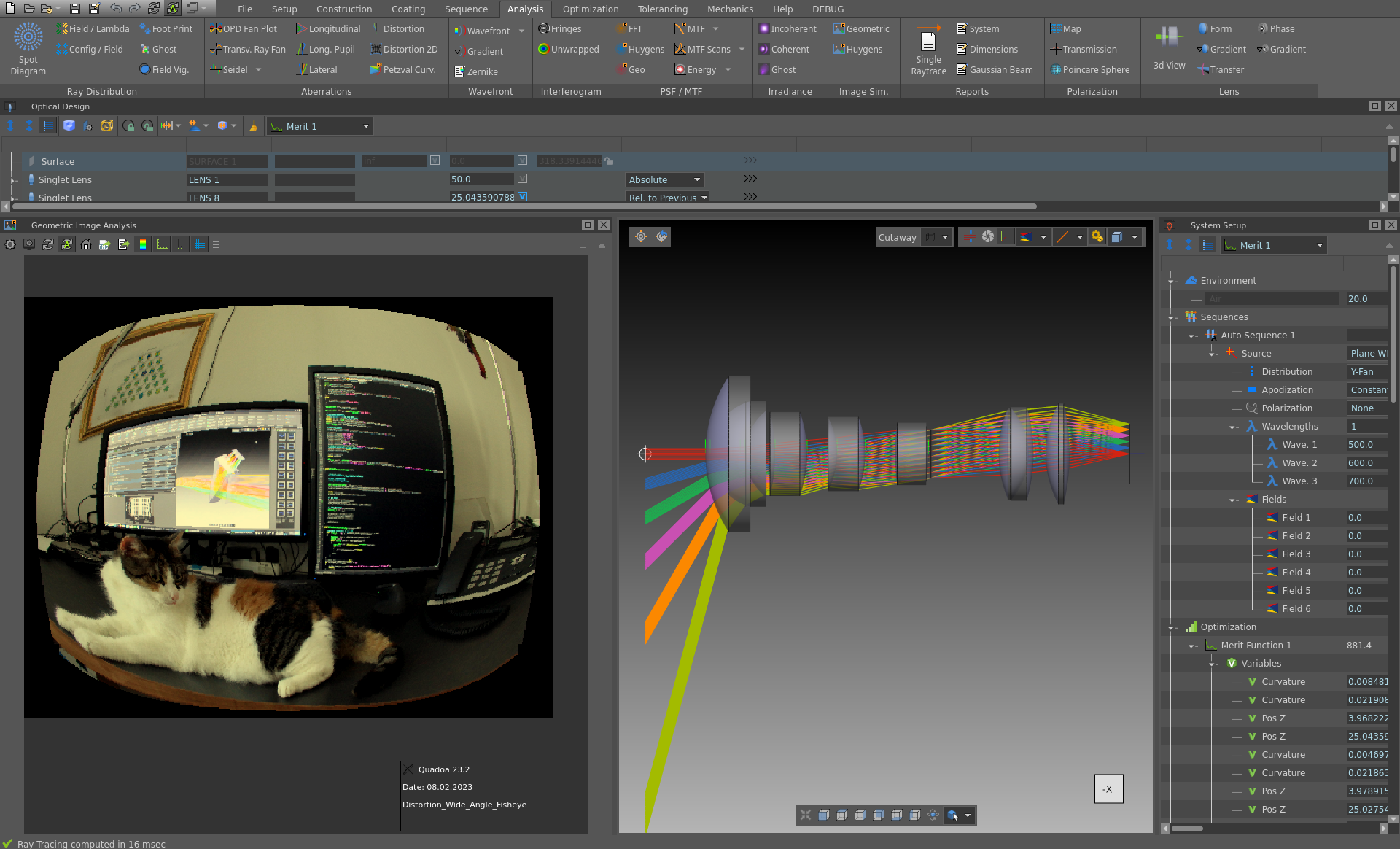
Image Simulation
QUADOA® provides Image Simulation capabilities based on the Geometric as well as the Huygens Point Spread Function.
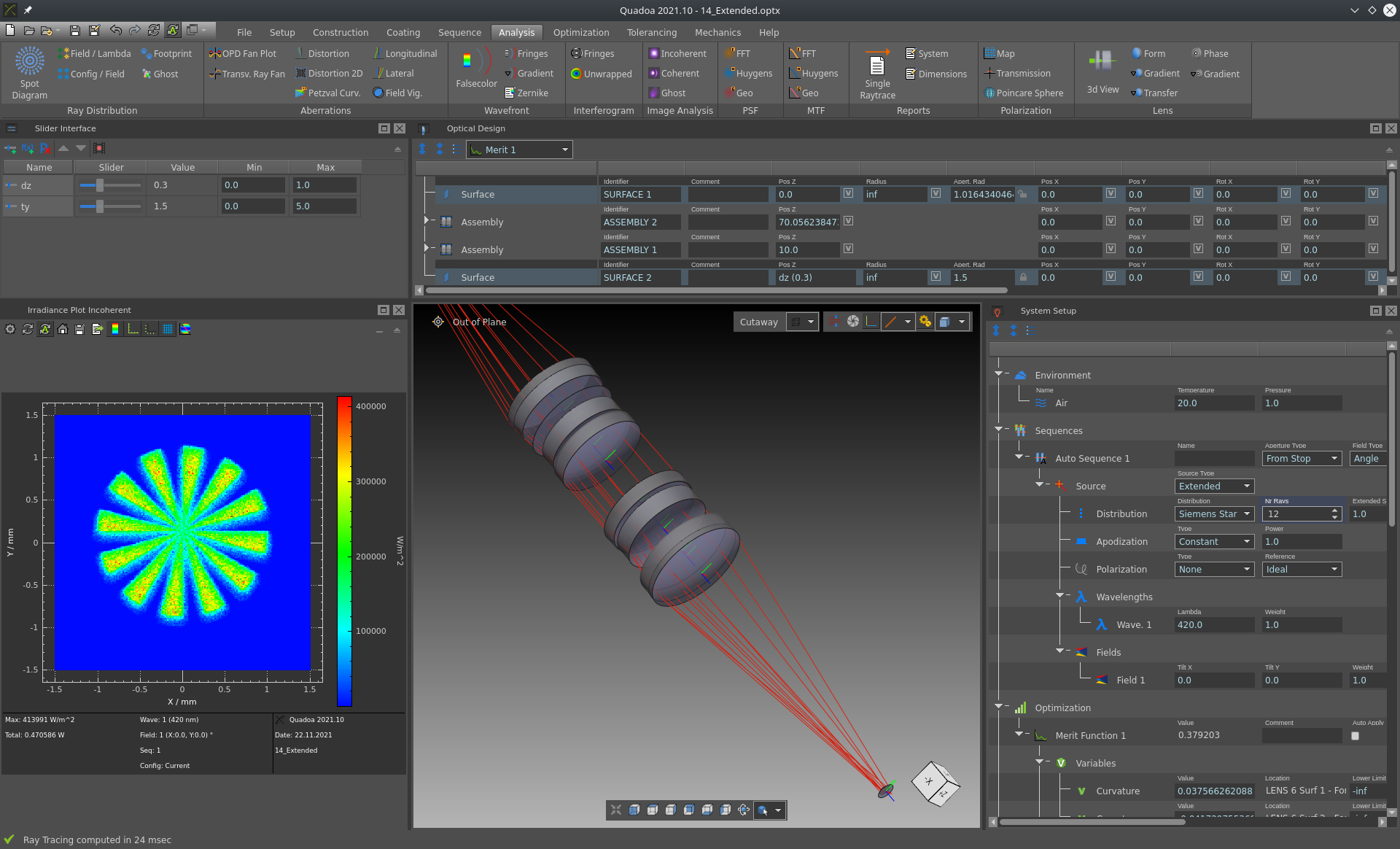
Siemens Star
Imaging of a Siemens Star pattern through optical system showing the image sharpness under the influence of defocus and coma.
VR/AR
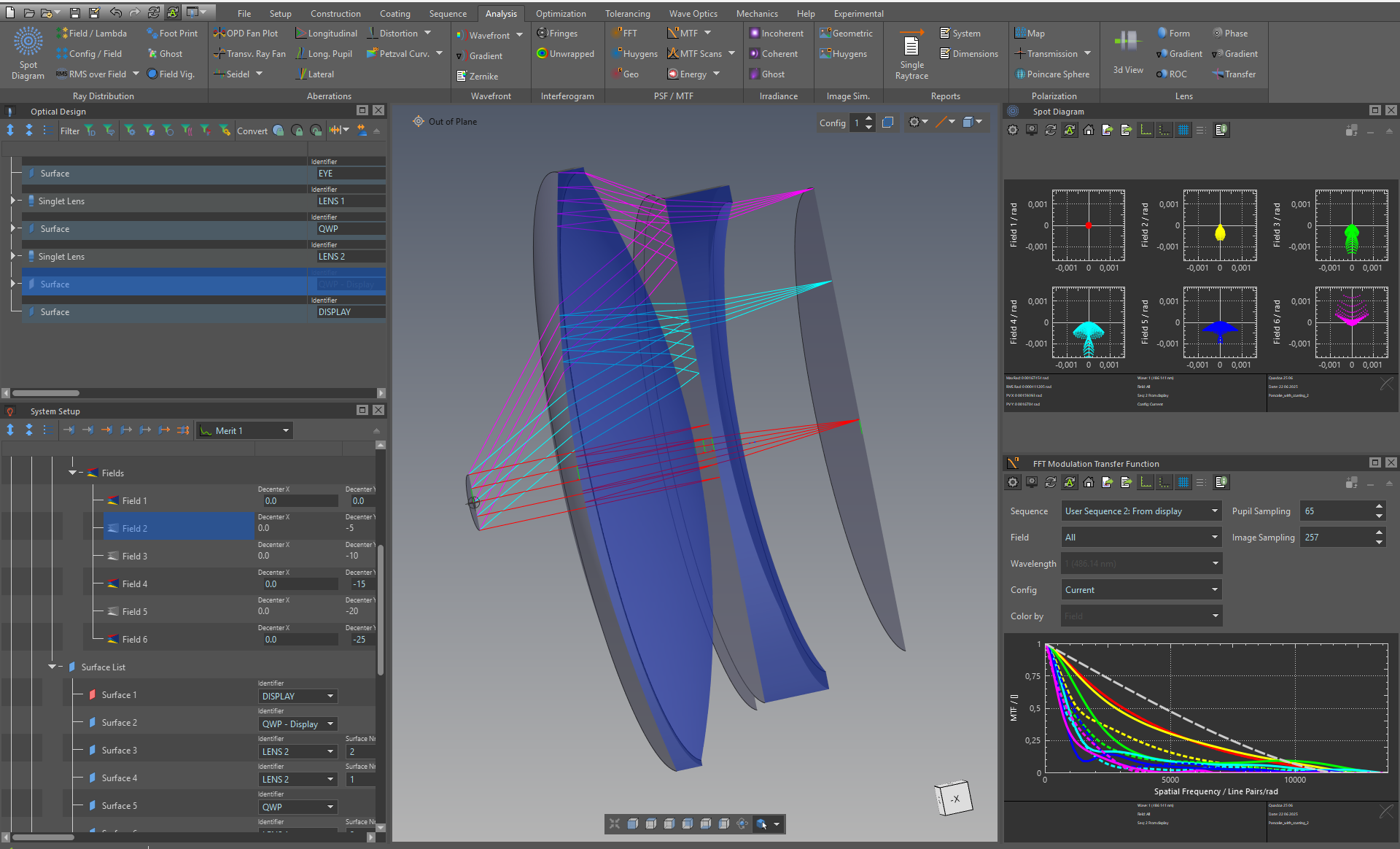
Pancake Lens for VR Systems
A compact pancake lens designed for VR systems, featuring a folded optical path for slimmer headset profiles and improved image clarity.
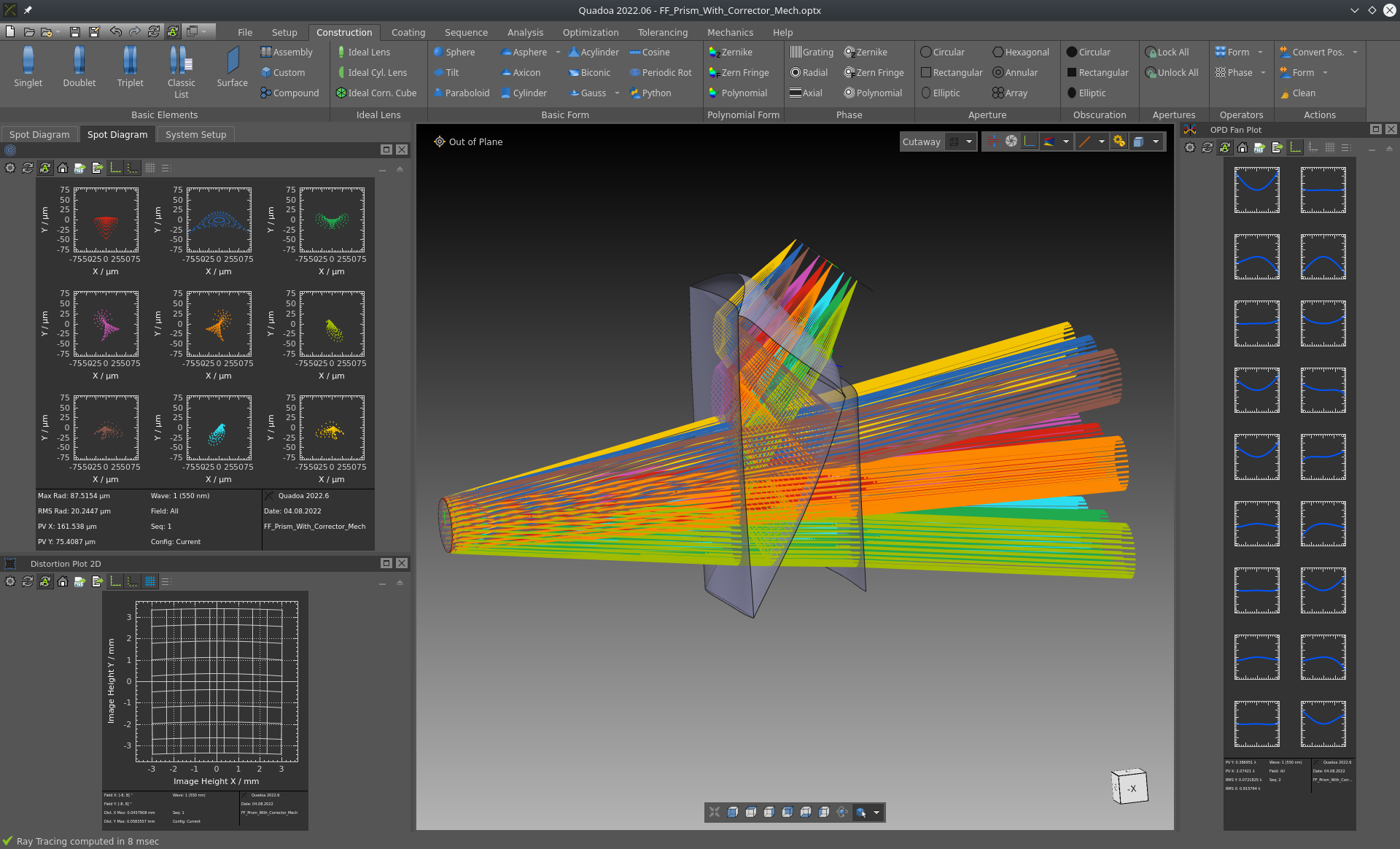
AR Freeform Prism
AR Freeform Prism using three Freeform Surfaces for the Prism and one for the Corrector.
Metrology / Sensors
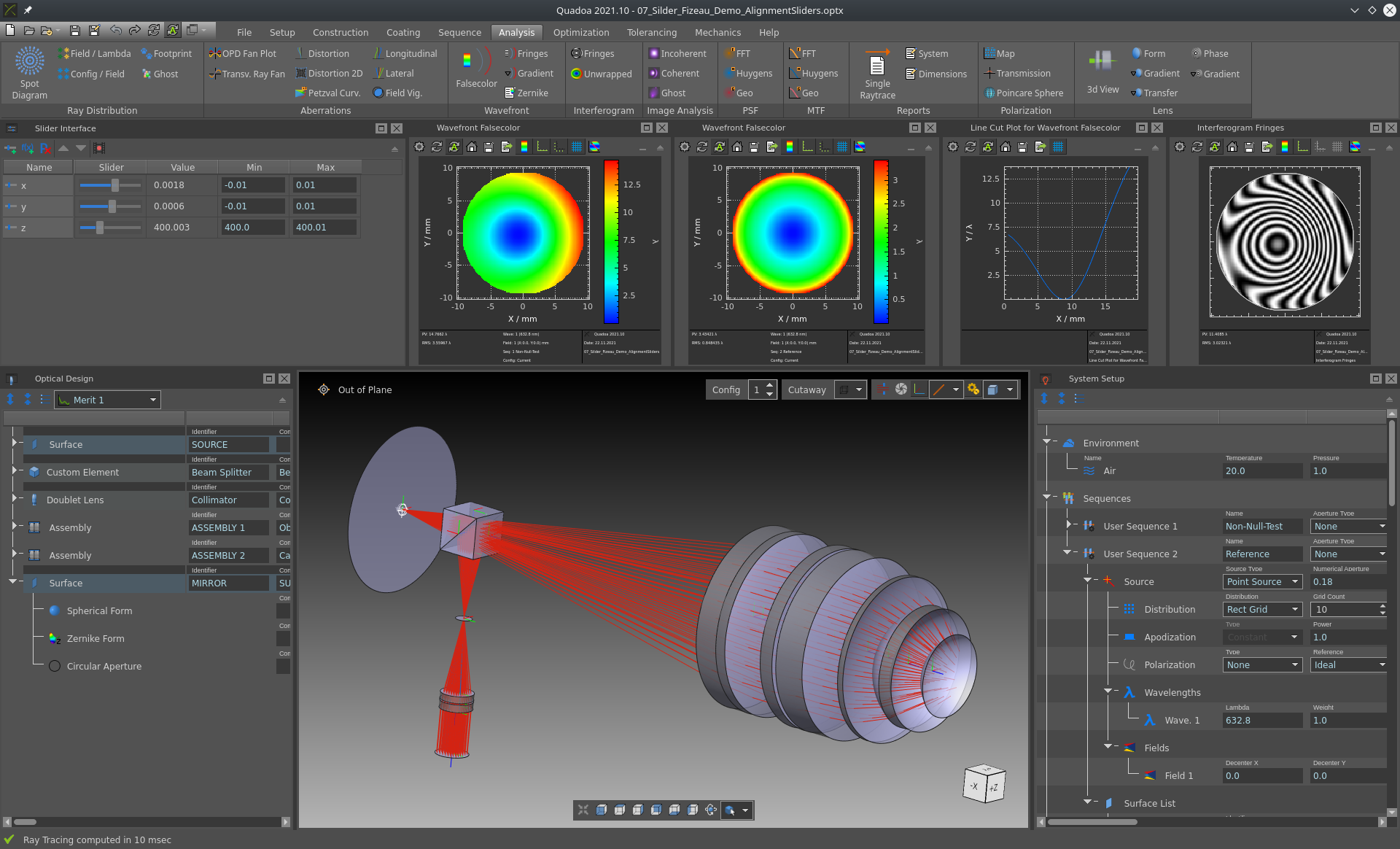
Fizeau Interferometer
Interferometer for the measurement of surface deviations that uses two sequential raytraces - one for the test arm and one for the reference arm.
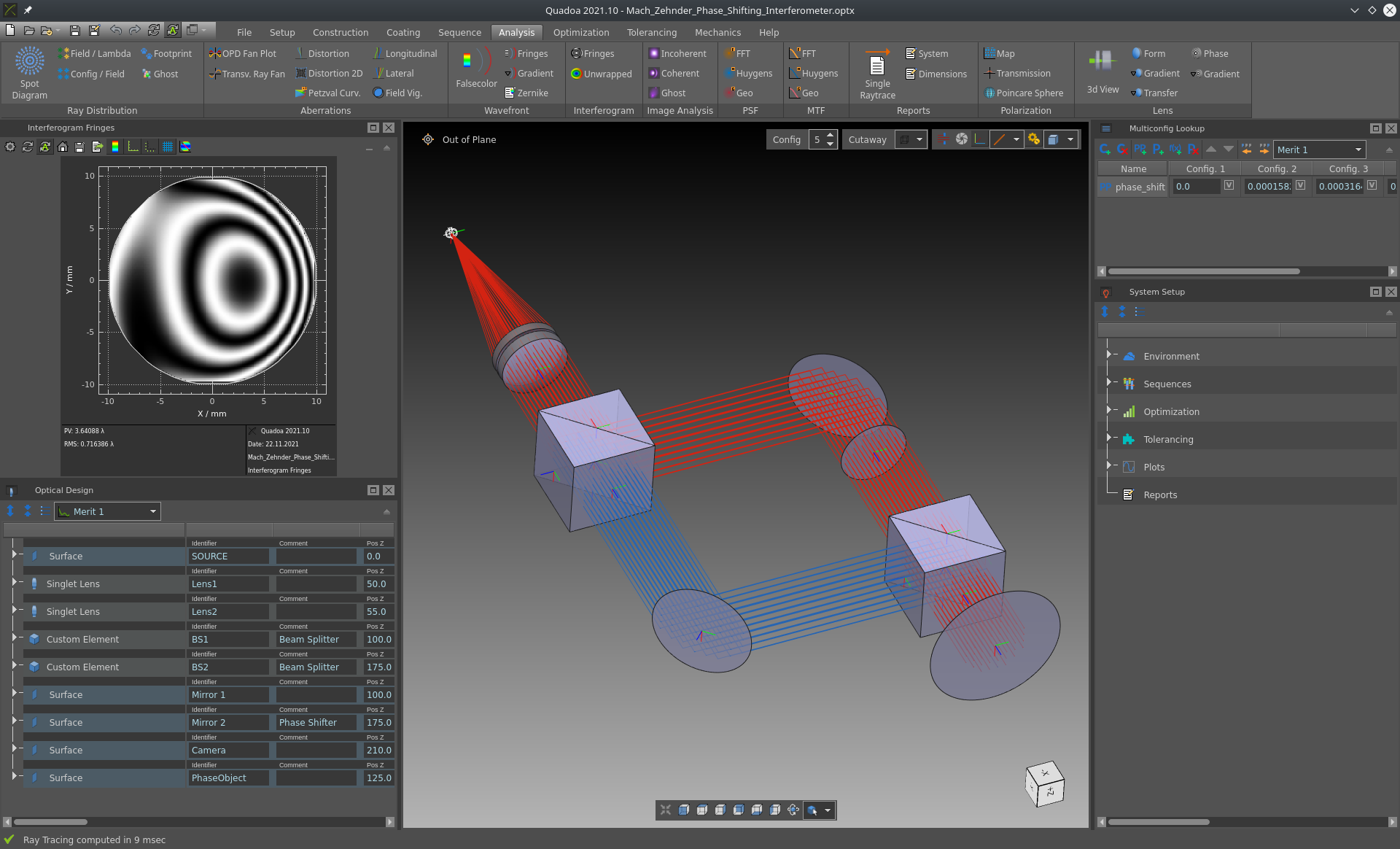
Mach Zehnder Phase Shifting Interferometer
Simulation of interferograms for the evaluation of phase shifting algorithms.
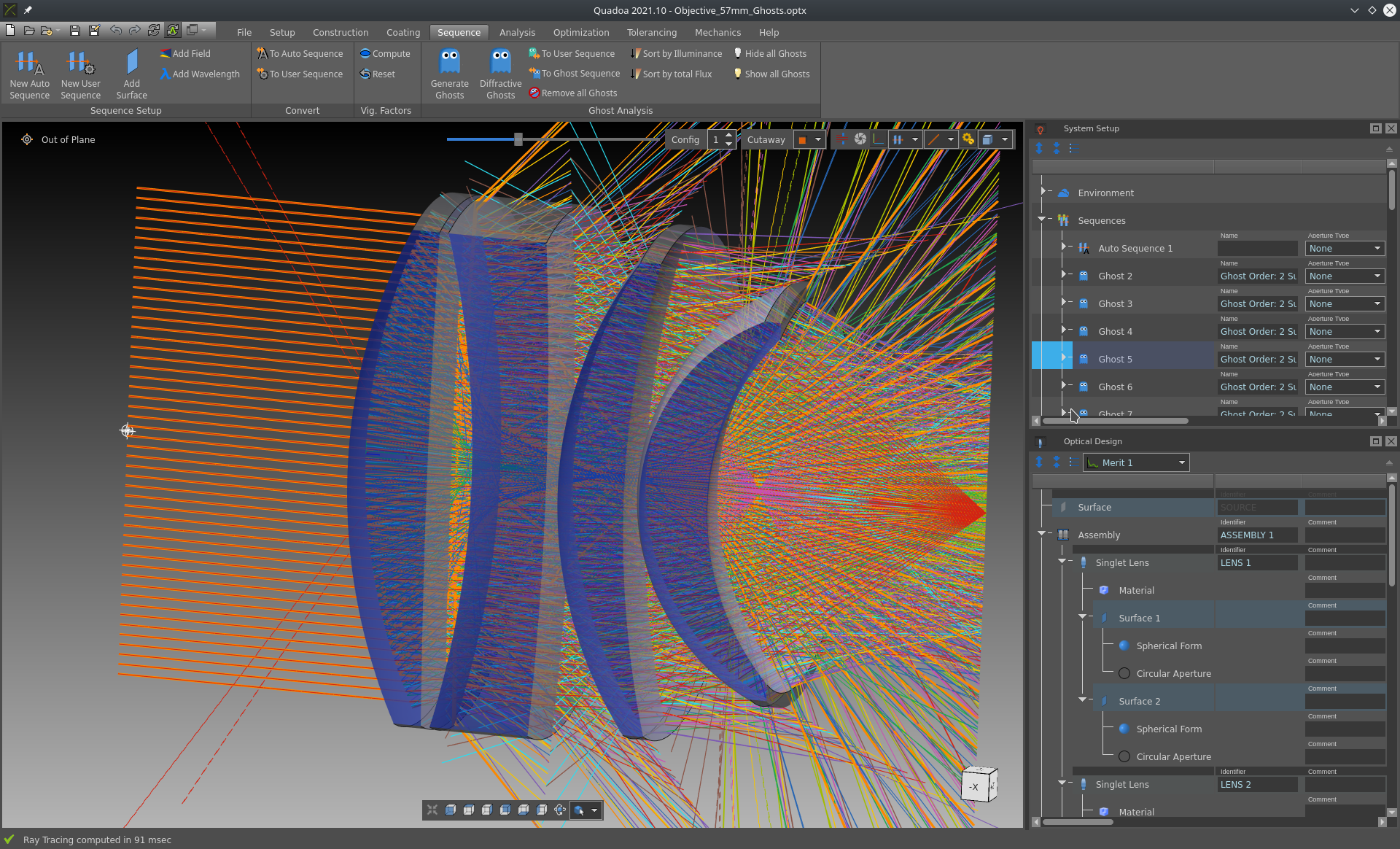
Integrated Live Ghost Analyzer: Interferometer Lens
Ghost reflex analysis to simulate the size and positions of ghost reflection inside an interferometric lens for the measurement of surface shapes.
Herriott Cell
Resonant cavity consisting of two spherical surfaces with a bundle of rays passing through the cavity 220 times.
Microscopy
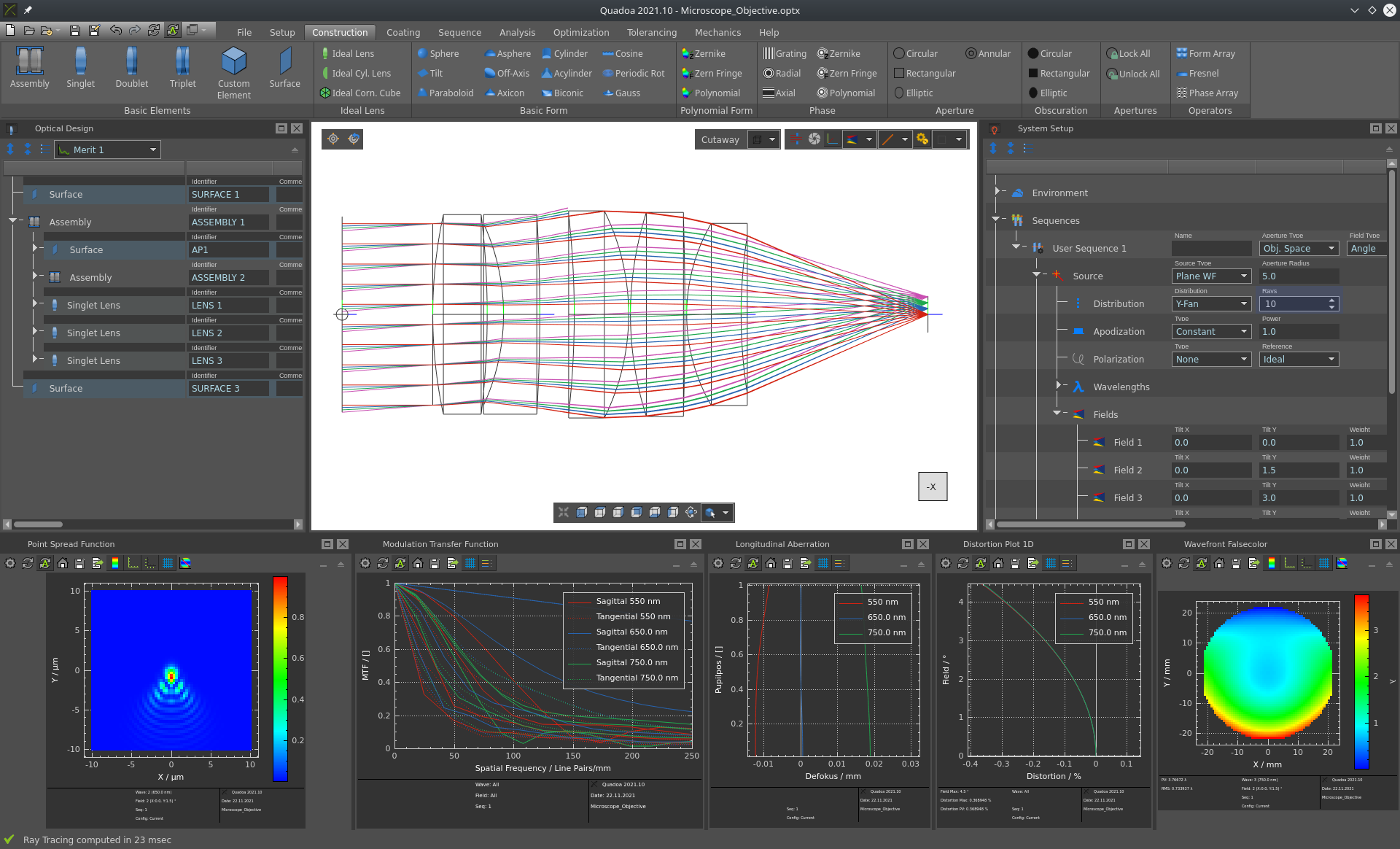
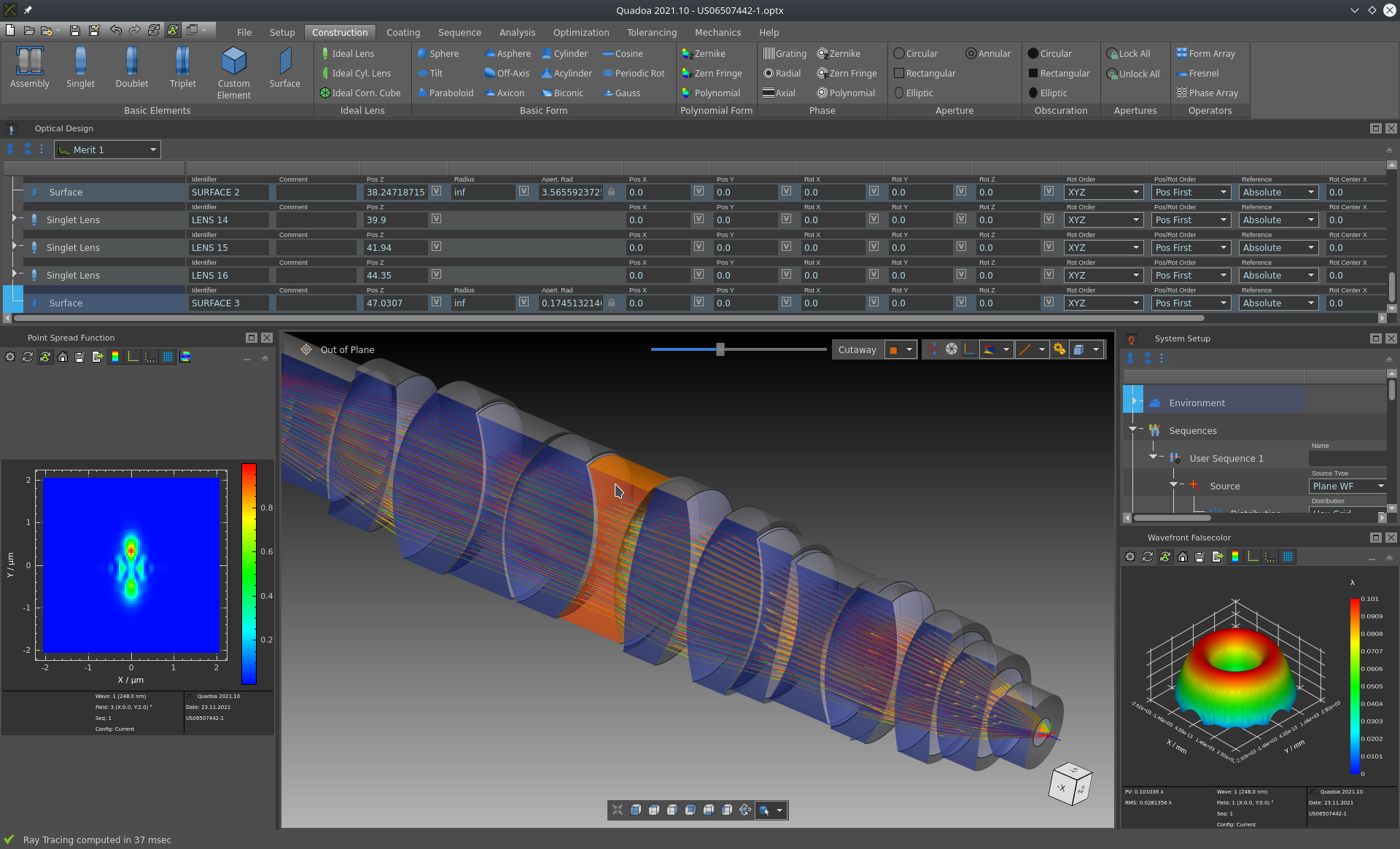
Microscope Objective: Misalignment Analysis
Analysing the impact of lens misalignment on the point spread function for a highly corrected microscope lens system.
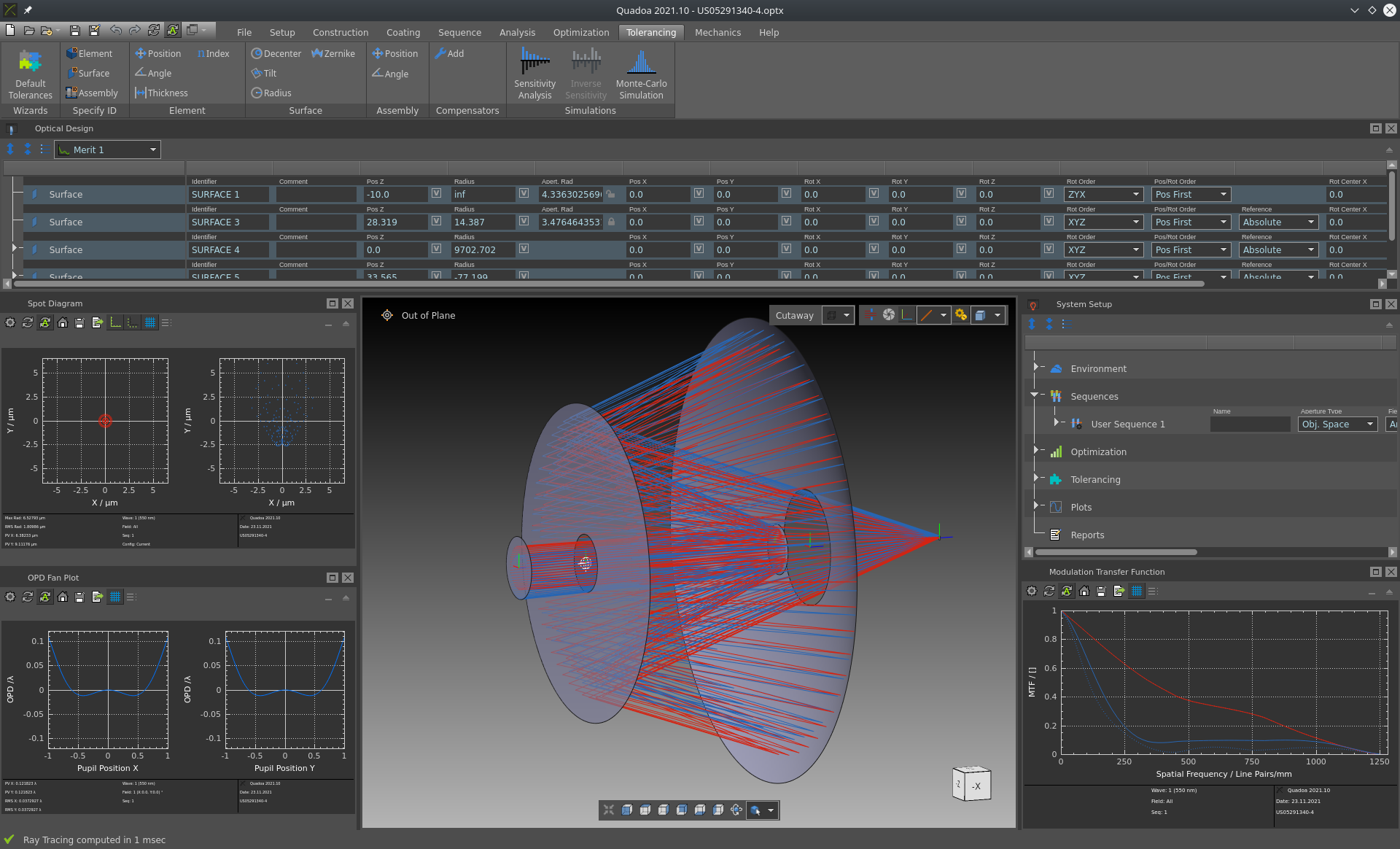
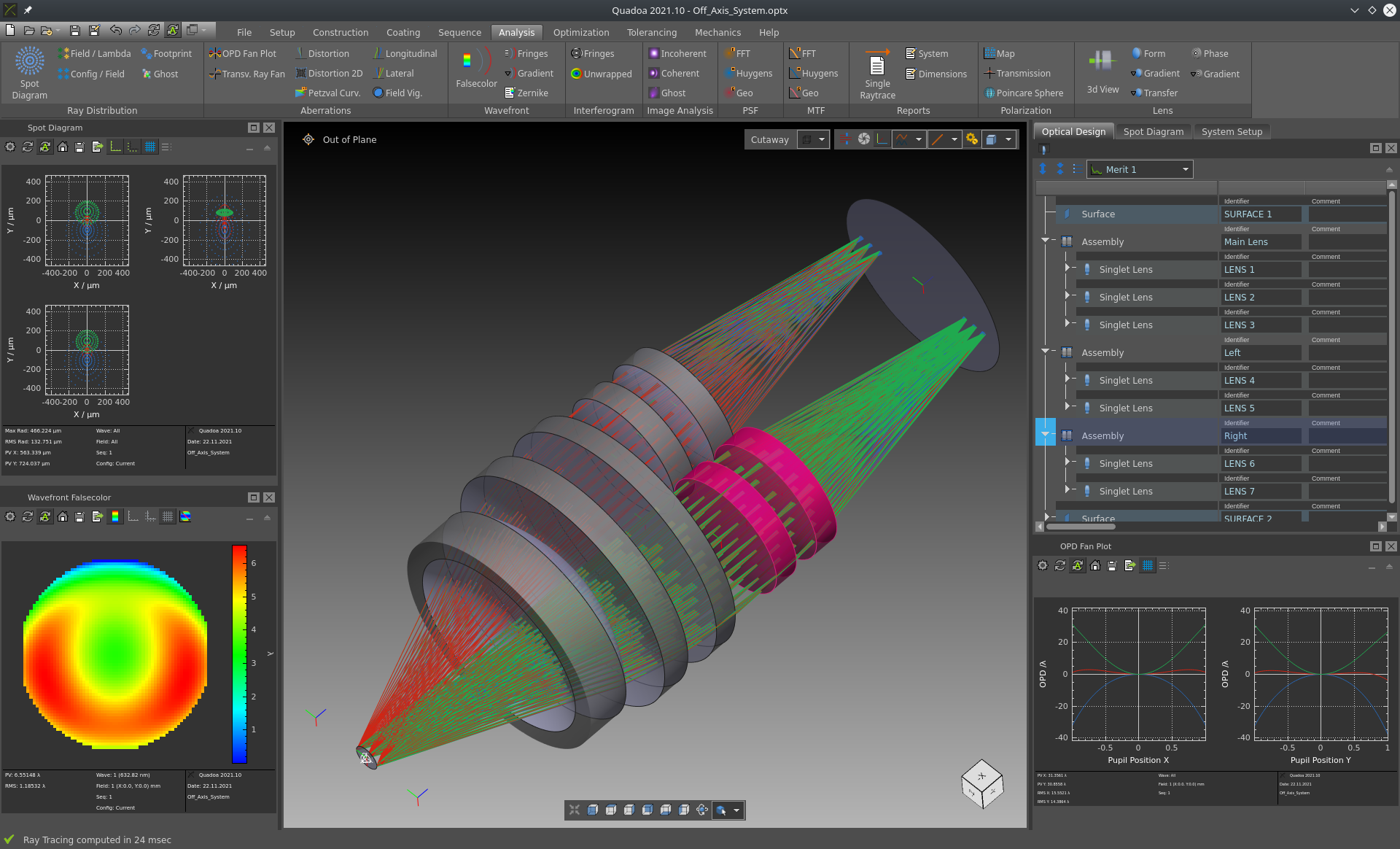
Stereo Lens
Stereoscopic system with two sequential ray tracing paths for the application in a stereoscopic microscope.
Semiconductor / Lithography
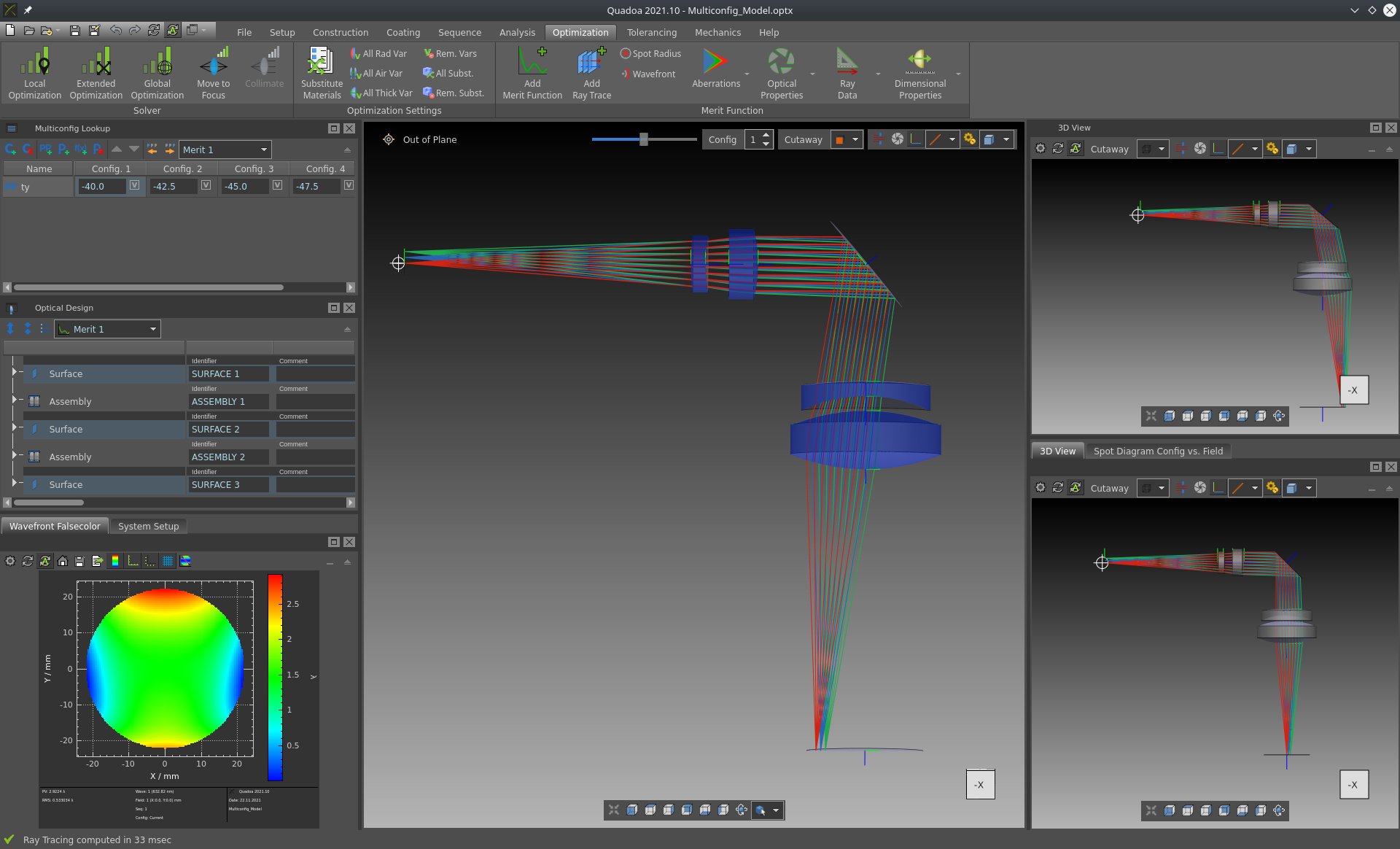
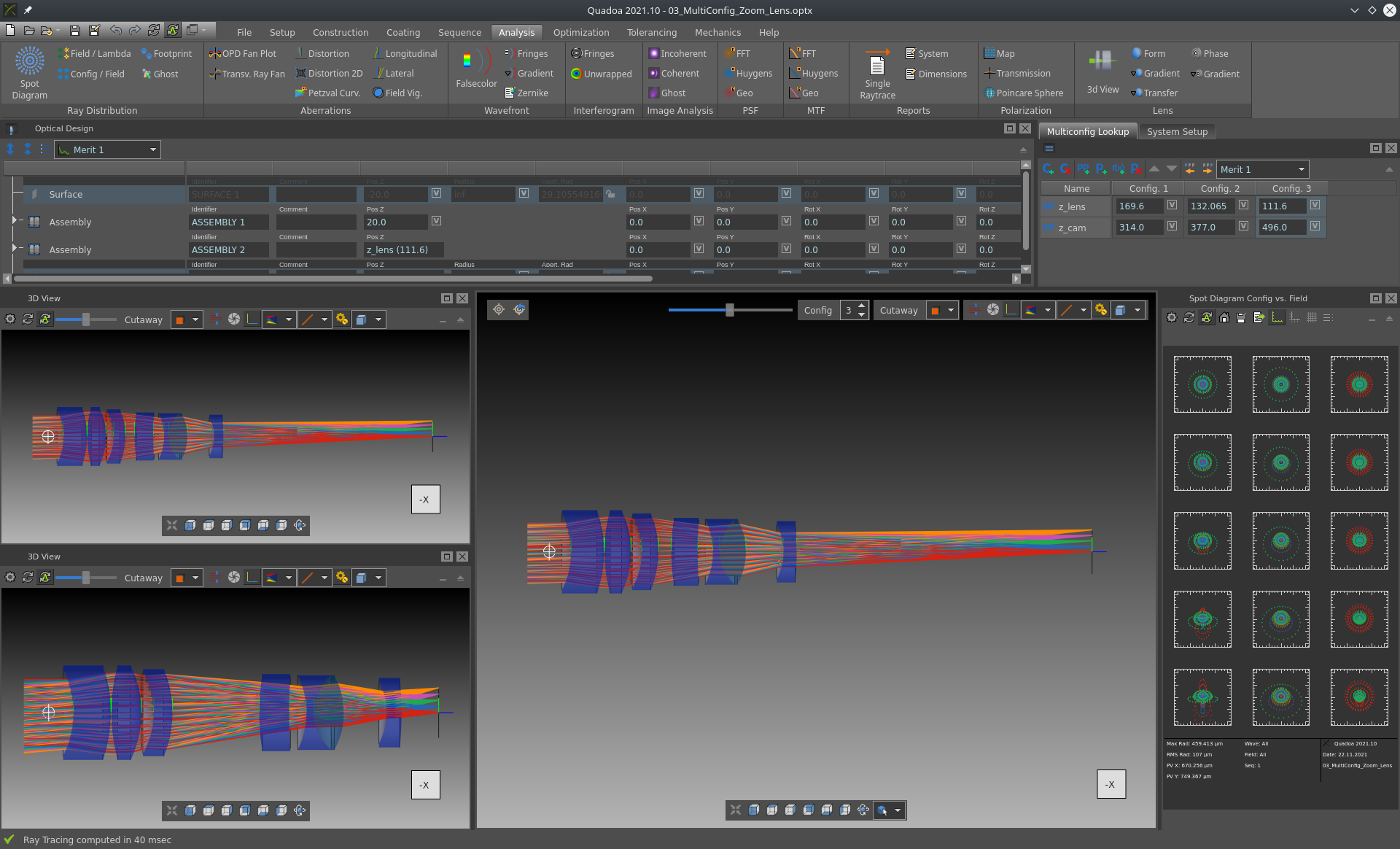
Multiconfiguration
Scanning mirror system to sequentially image a surface for quality control in pcb fabrication.
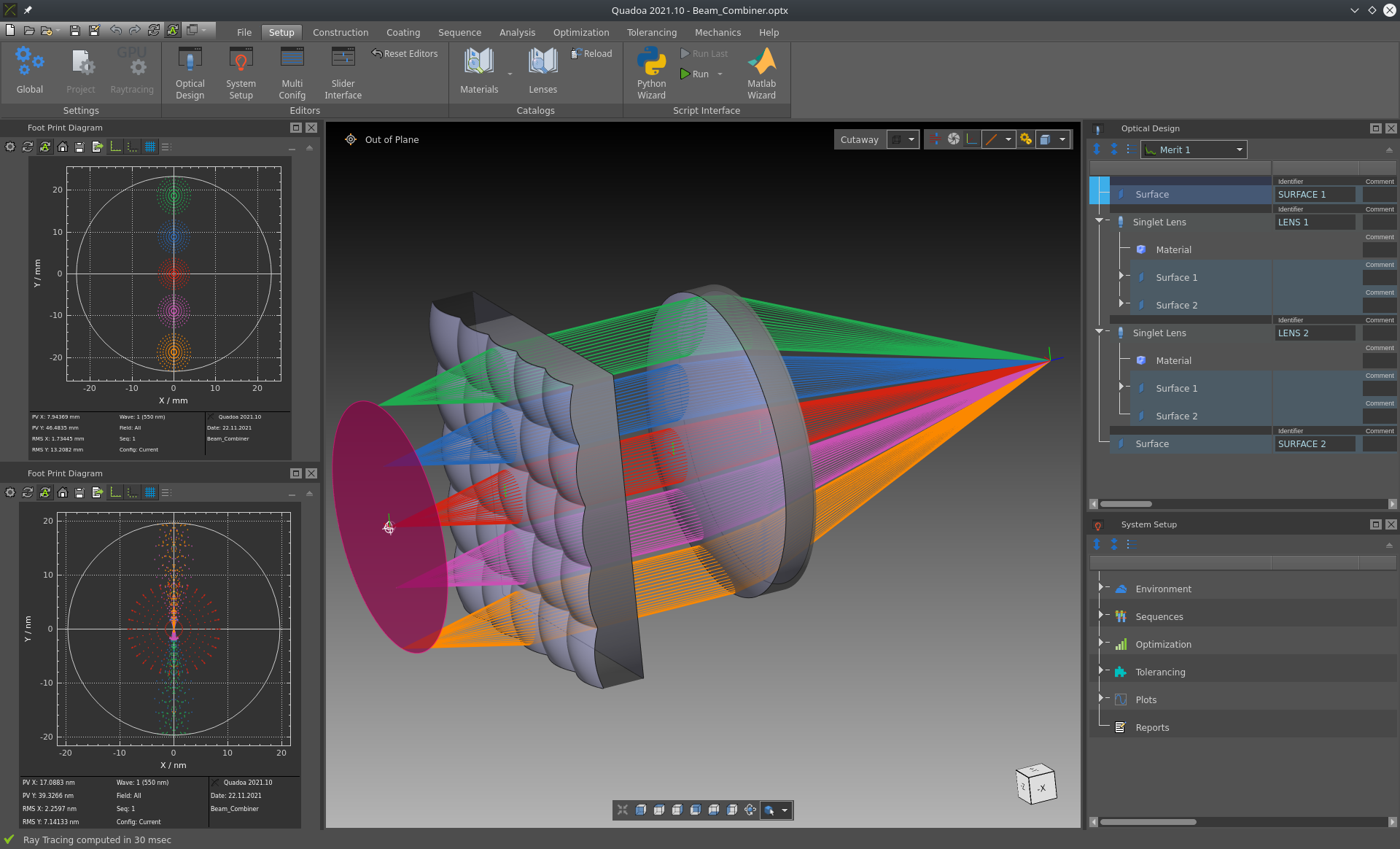
Beam Combiner
Micro lens array that combines the output of an array of laser emitters onto a single focal point.
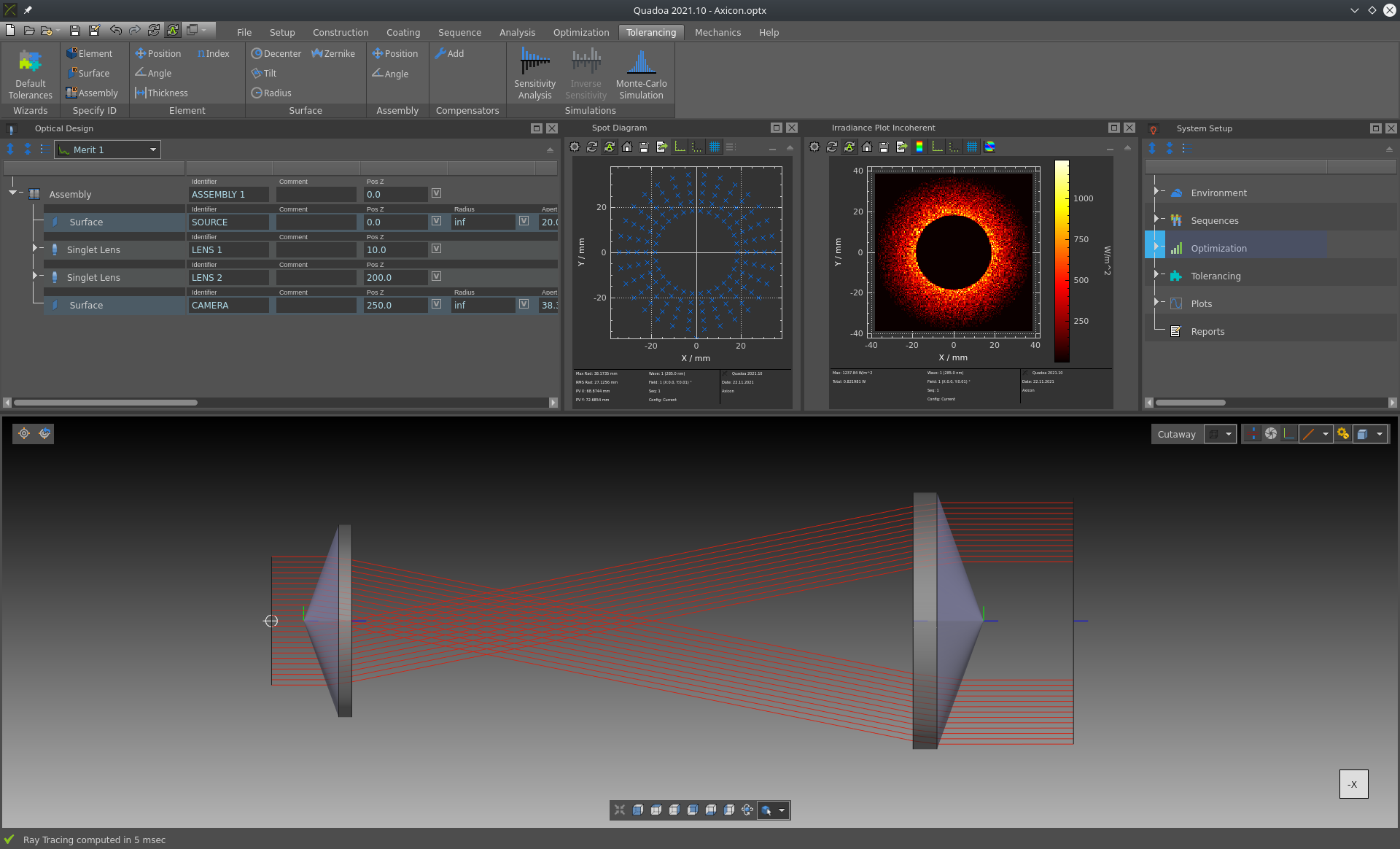
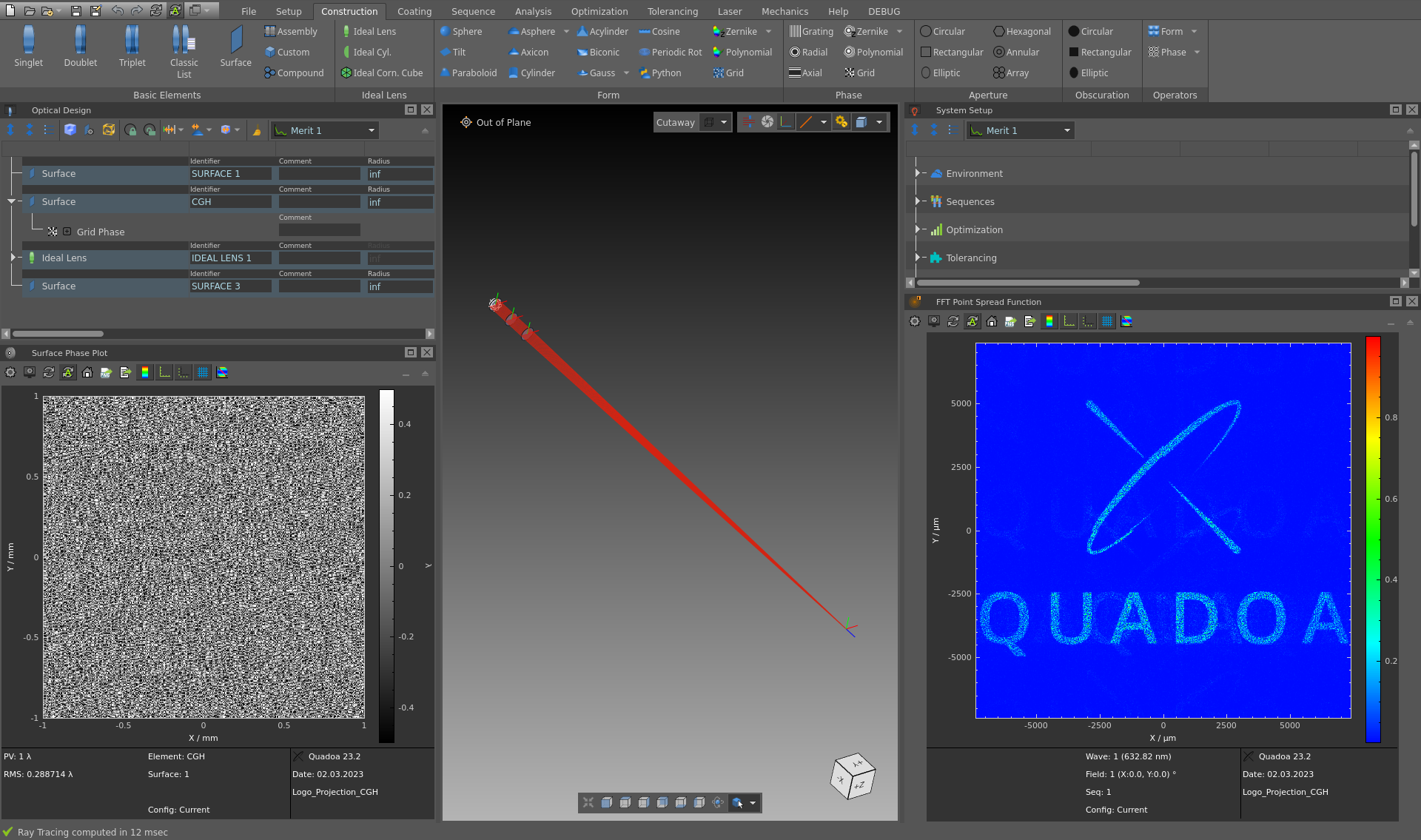
Computer generated hologram
Simulation of a CGH (computer generated hologram) that was designed to project the QUADOA® logo onto a surface.
Telescopes / Space
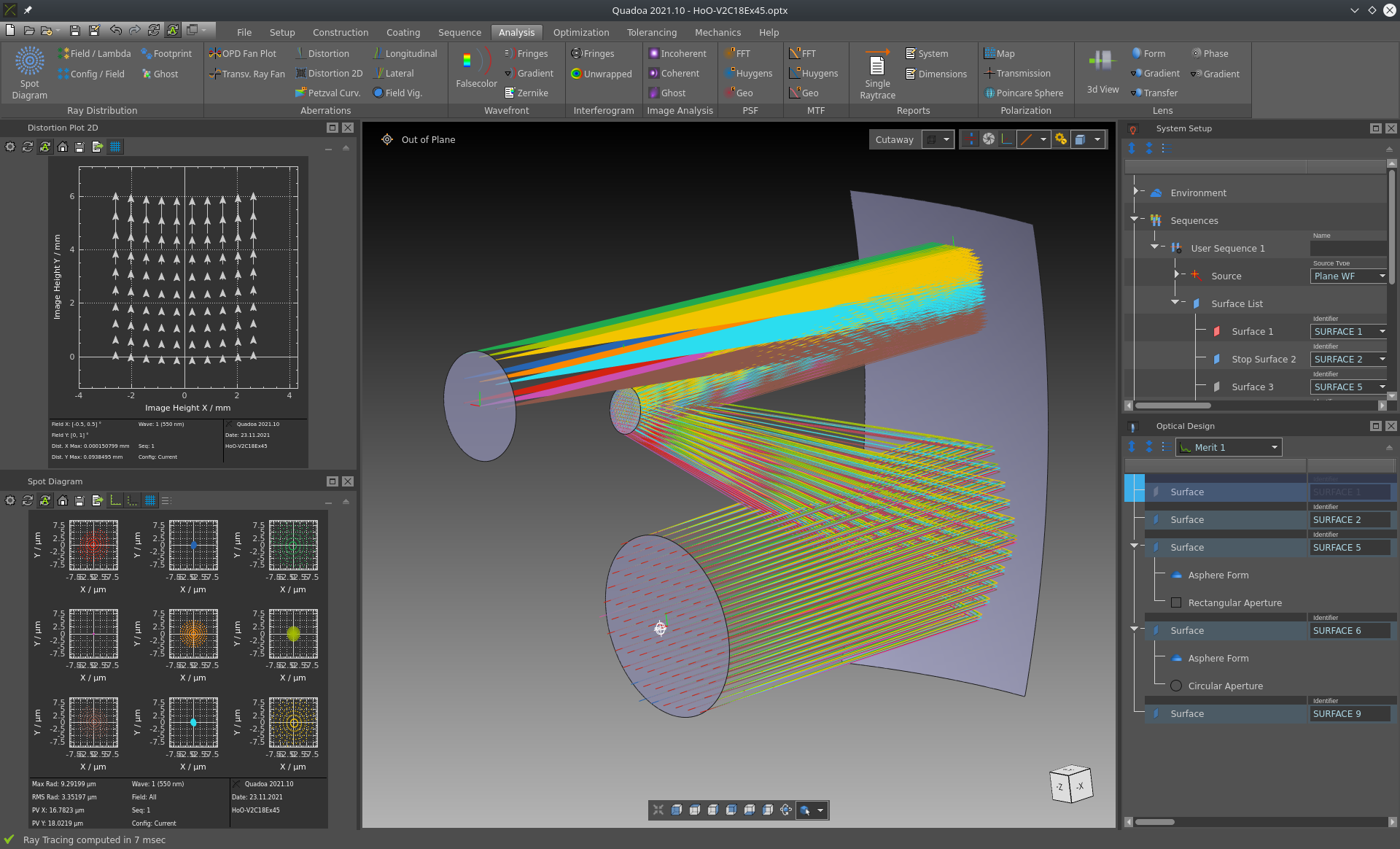
Off-Axis Telescope
Compact mirror telescope design that uses the same component as primary and tertiary mirror which simplifies the alignment of the components.
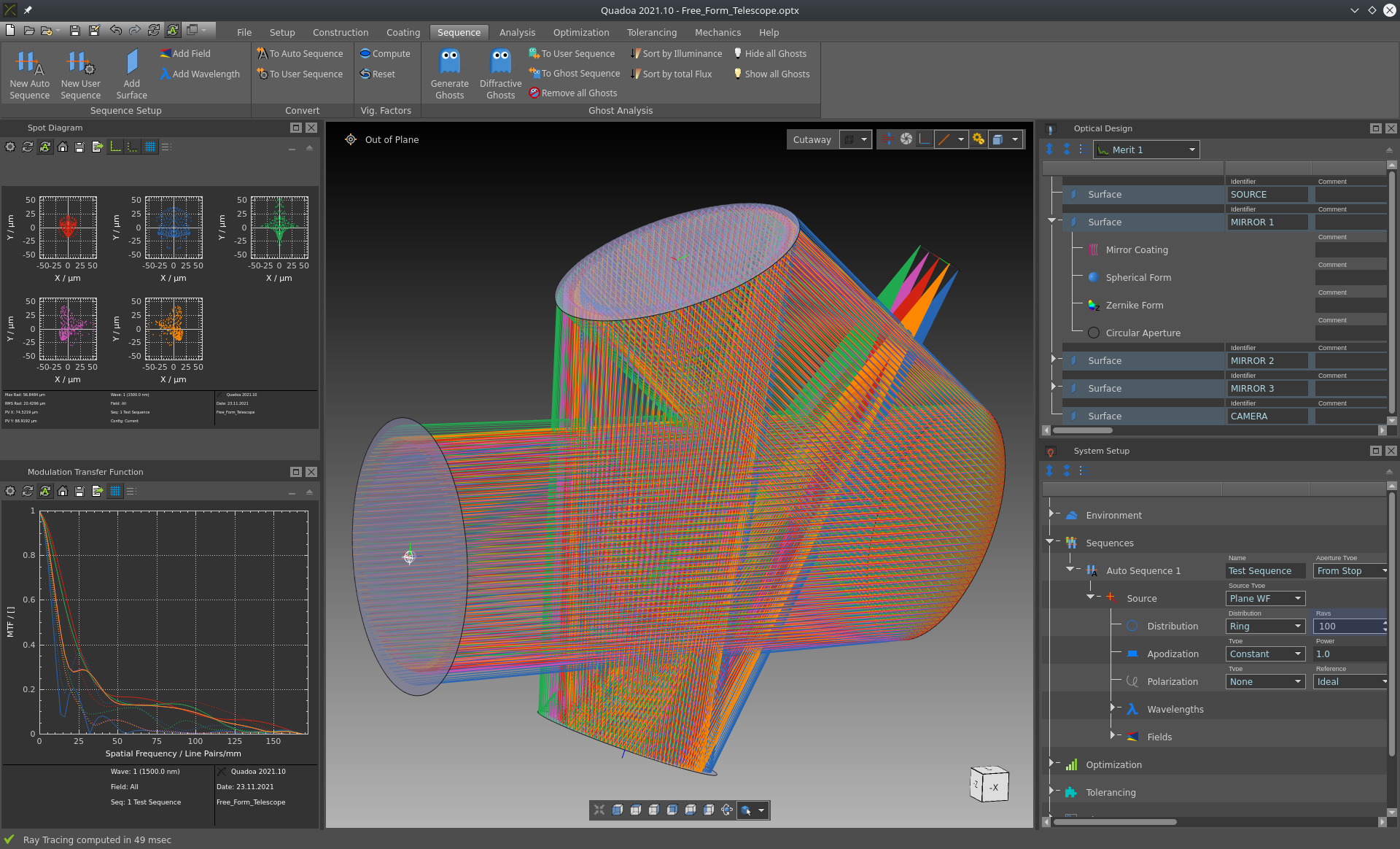
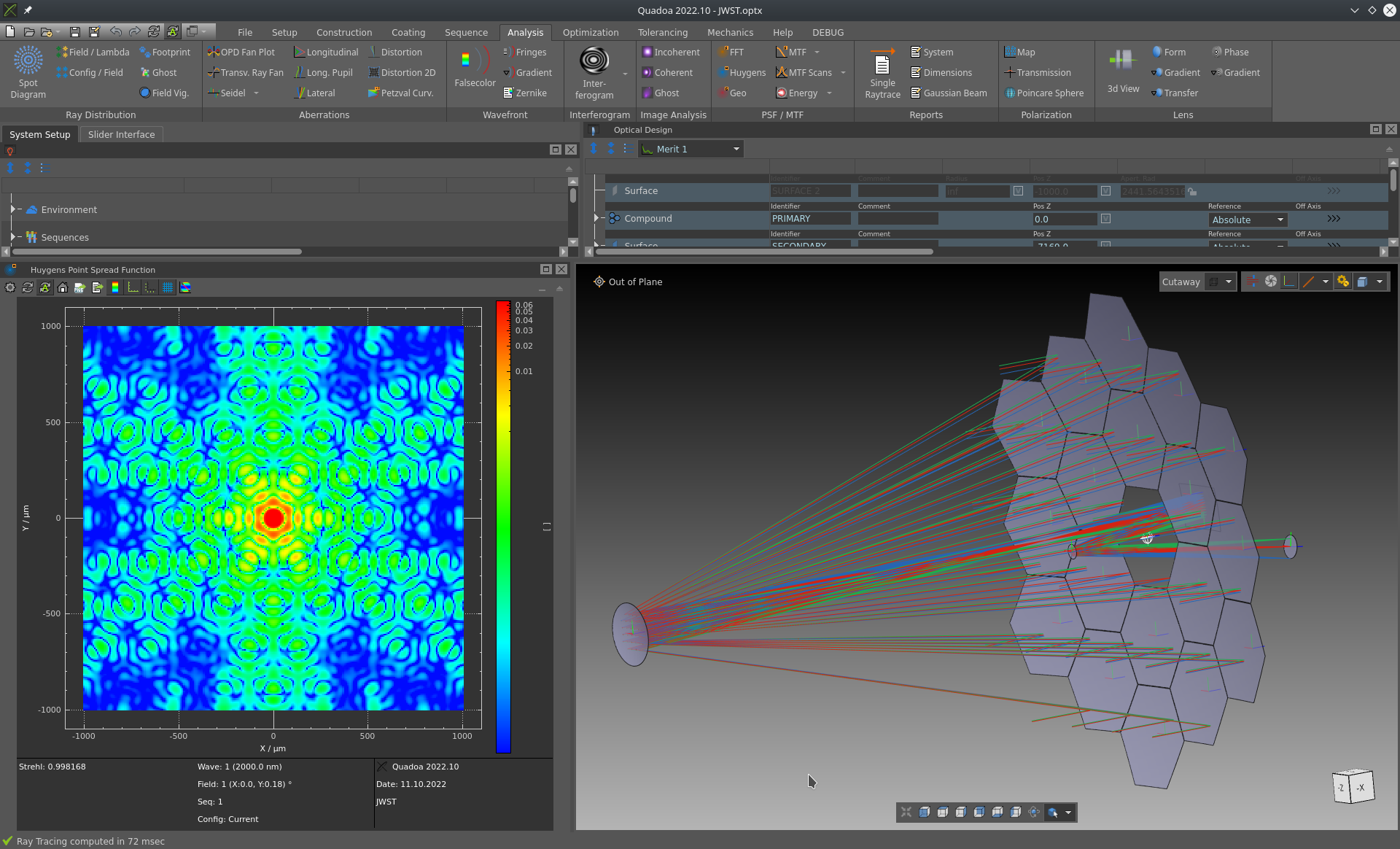
Compound Surfaces
The Compound Surface allows to define an optical Surface that is assembled out of several Surfaces. In the example the JWST is used to demonstrate this Surface type.
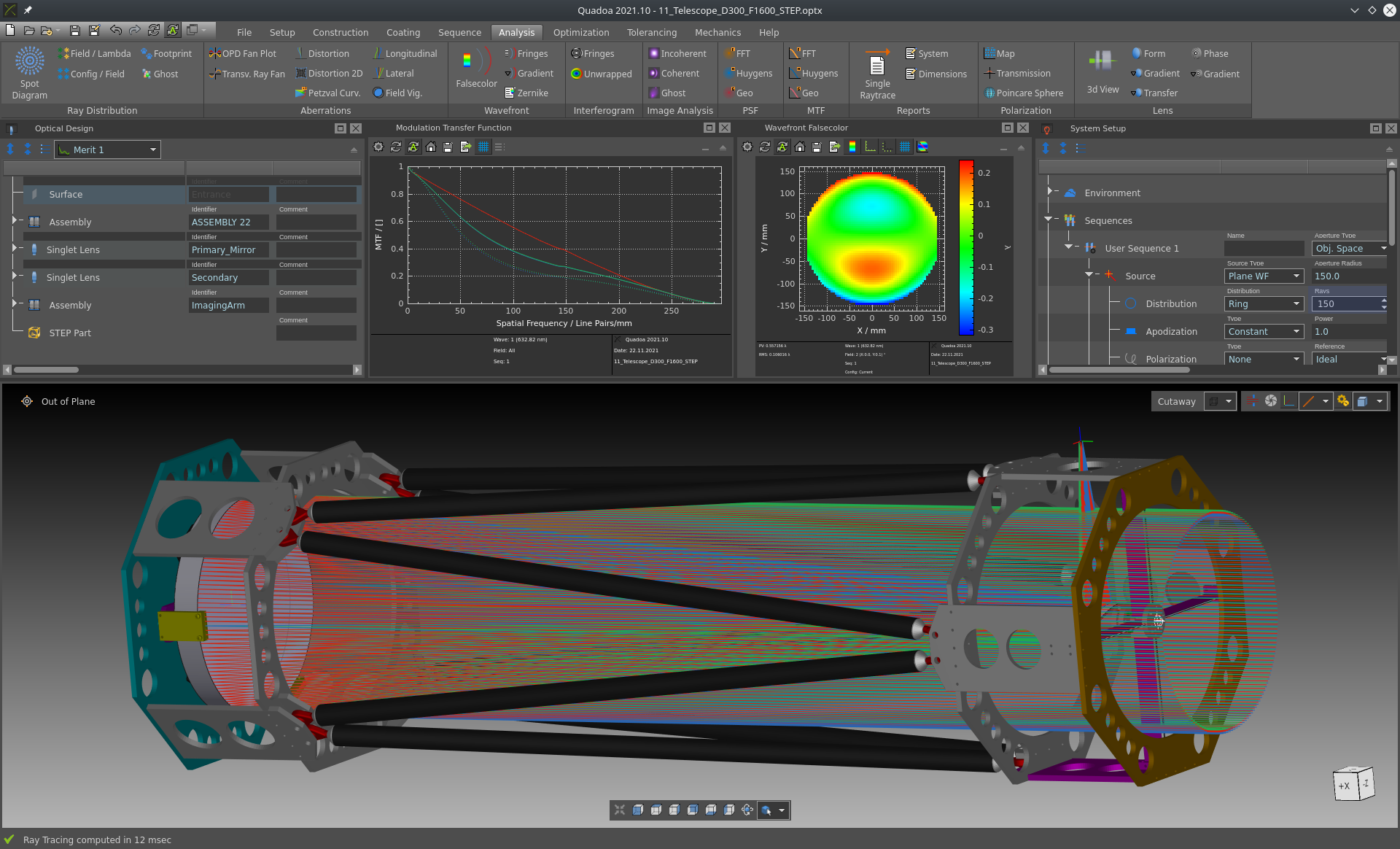
Mechanics Integration for Telescope
Newton type telescope design showing the combined opto-mechanical system capability of QUADOA®.
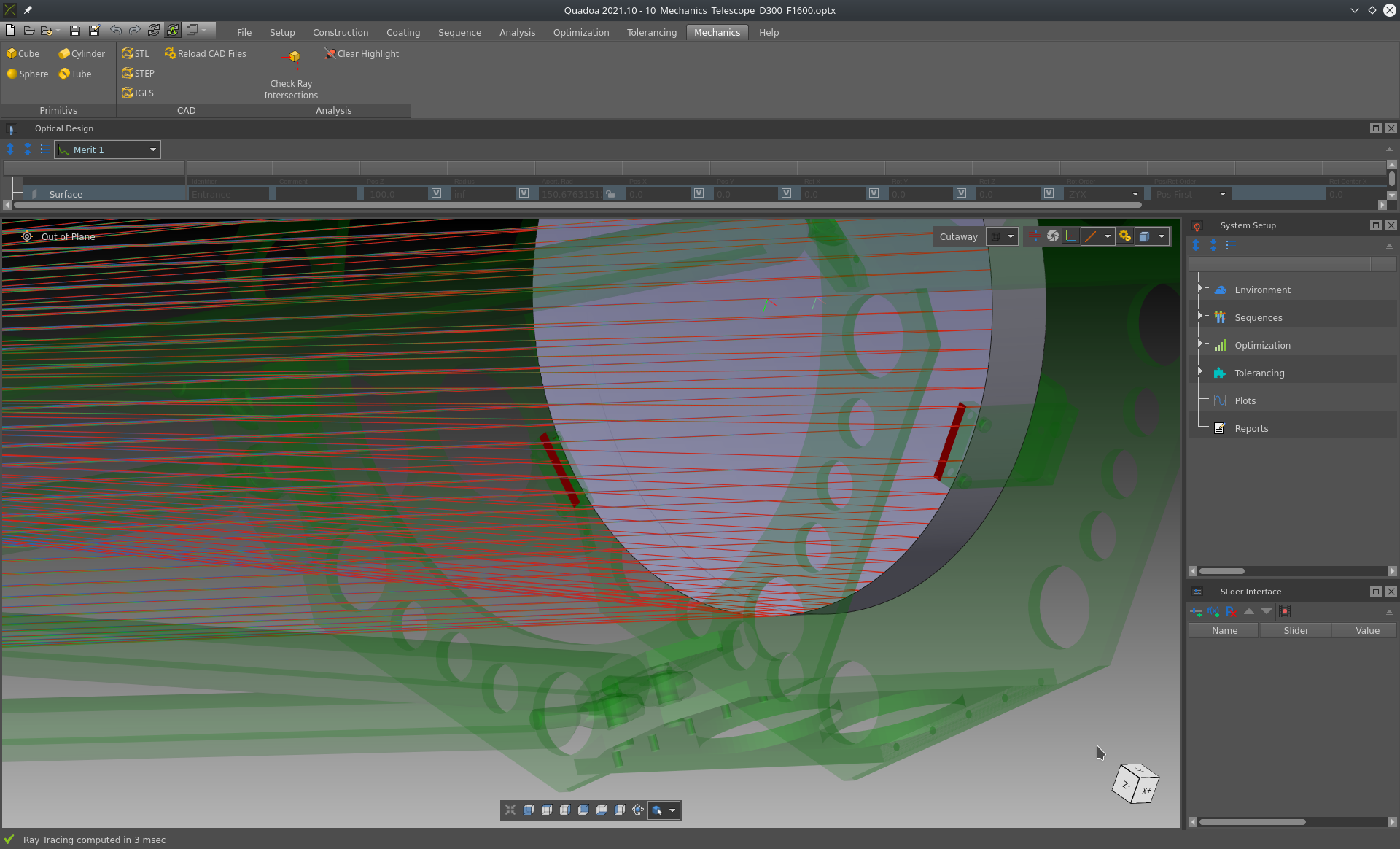
Mechanics Intersection Analyzer
Detection of intersections between mechanics and rays at mirror-clamps holding an parabolic mirror.
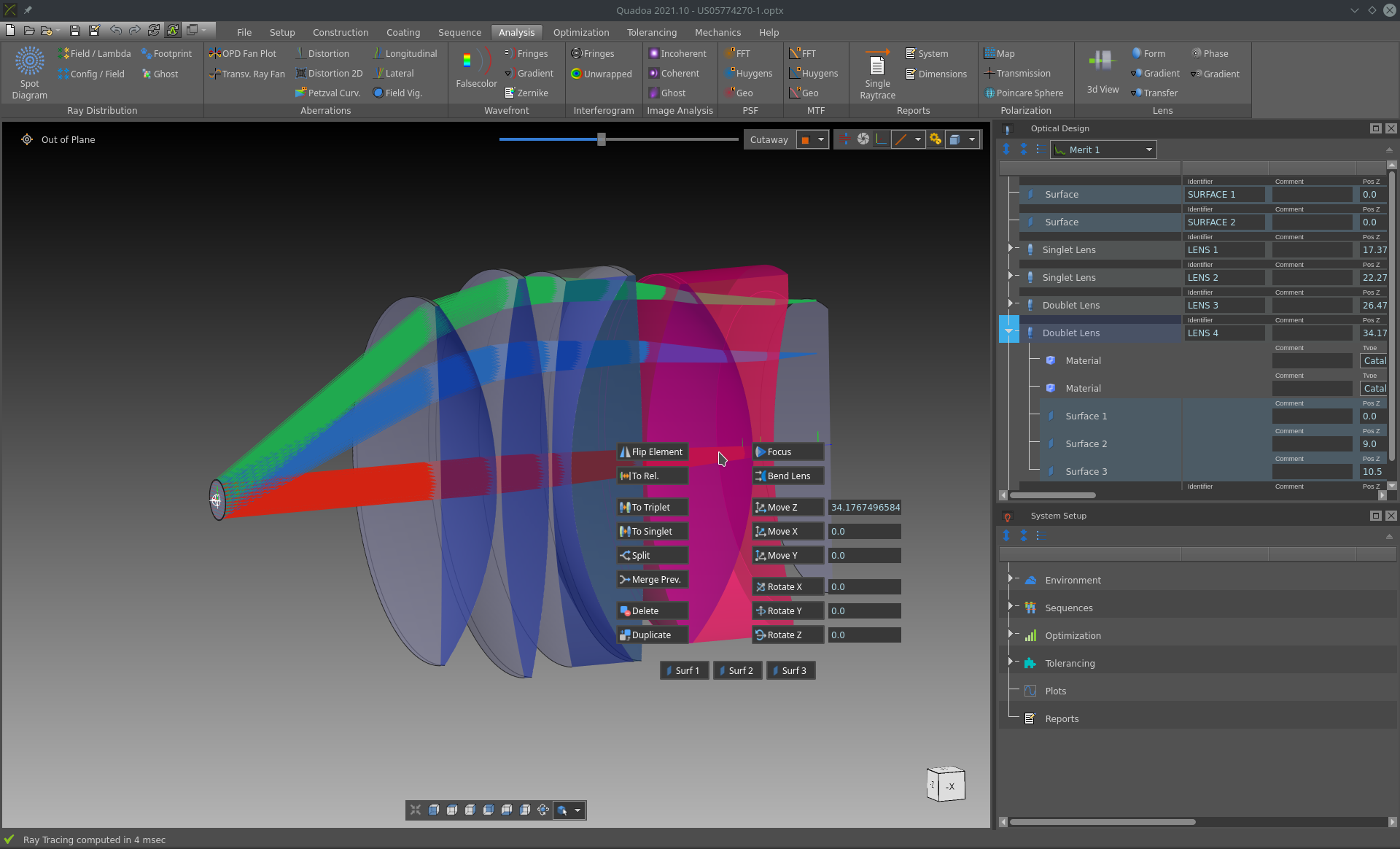
Eye Piece
Eye piece for the usage in a telescope system for the observation of astronomical objects.
Software features
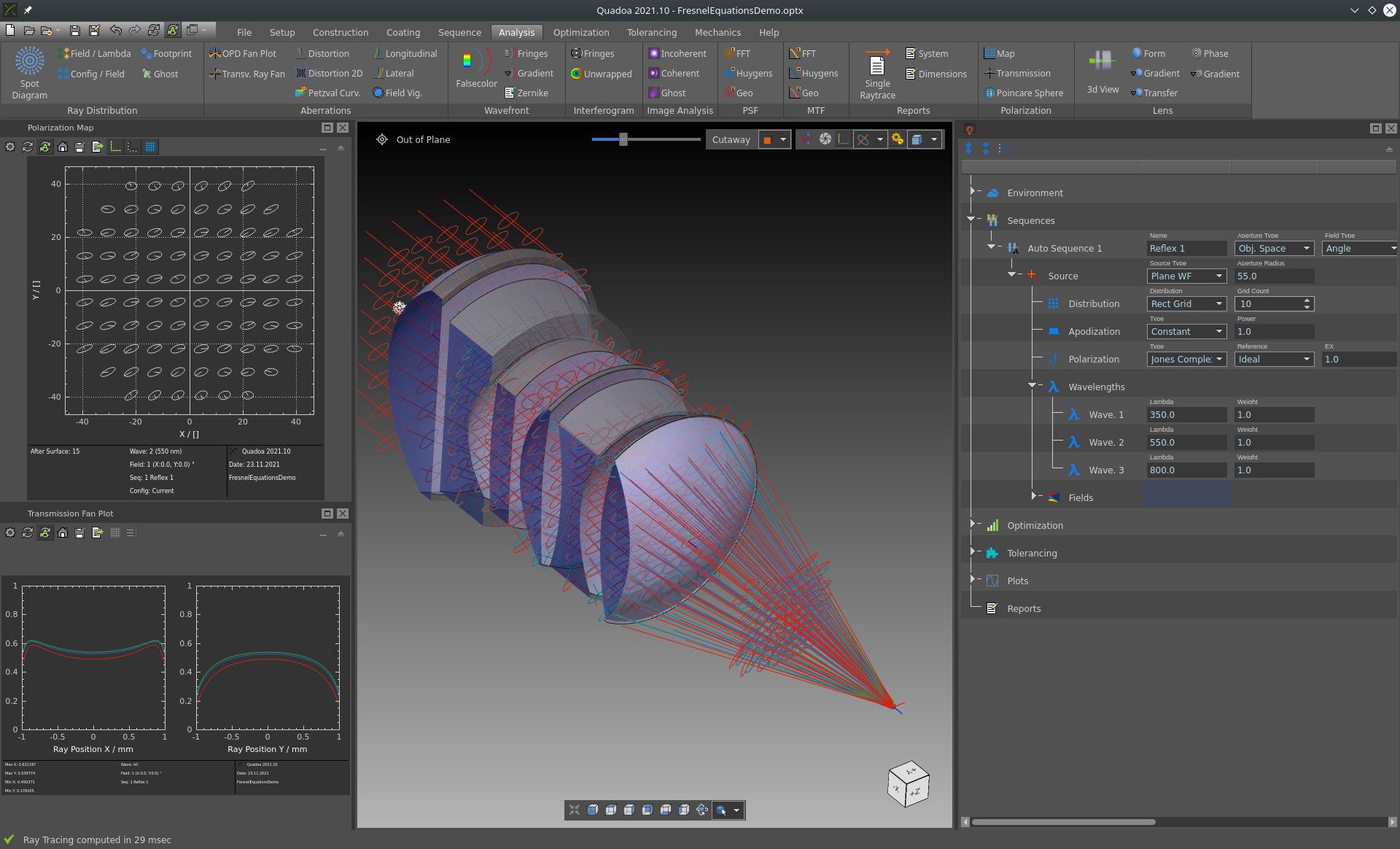
Polarization
Polarization Ray Tracing analysis to visualize the polarization state of linear polarized light after passing a lens system.
Point Spread Function
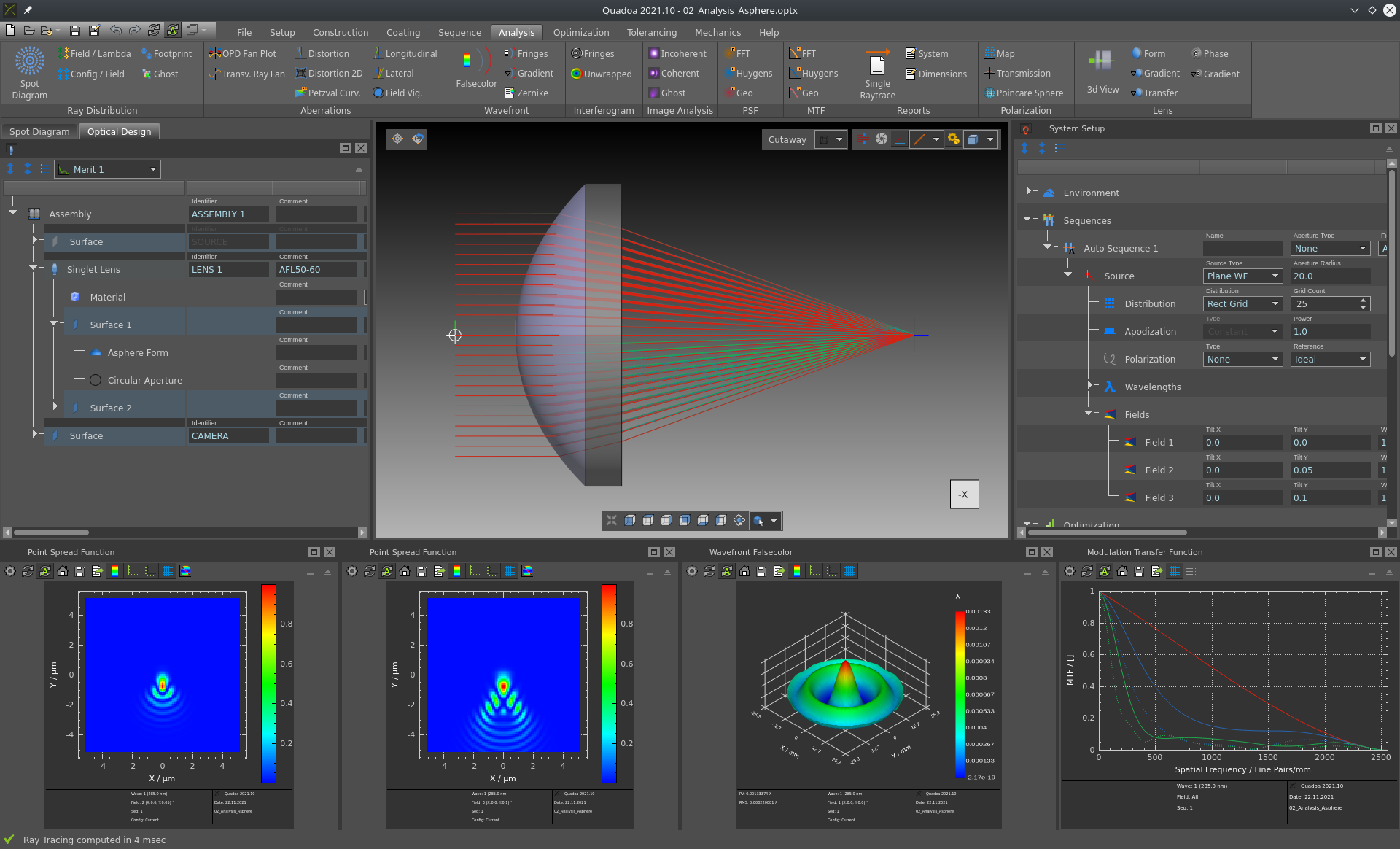
Analysis of the point spread function for a simple aspheric lens under the influence of misalignment.
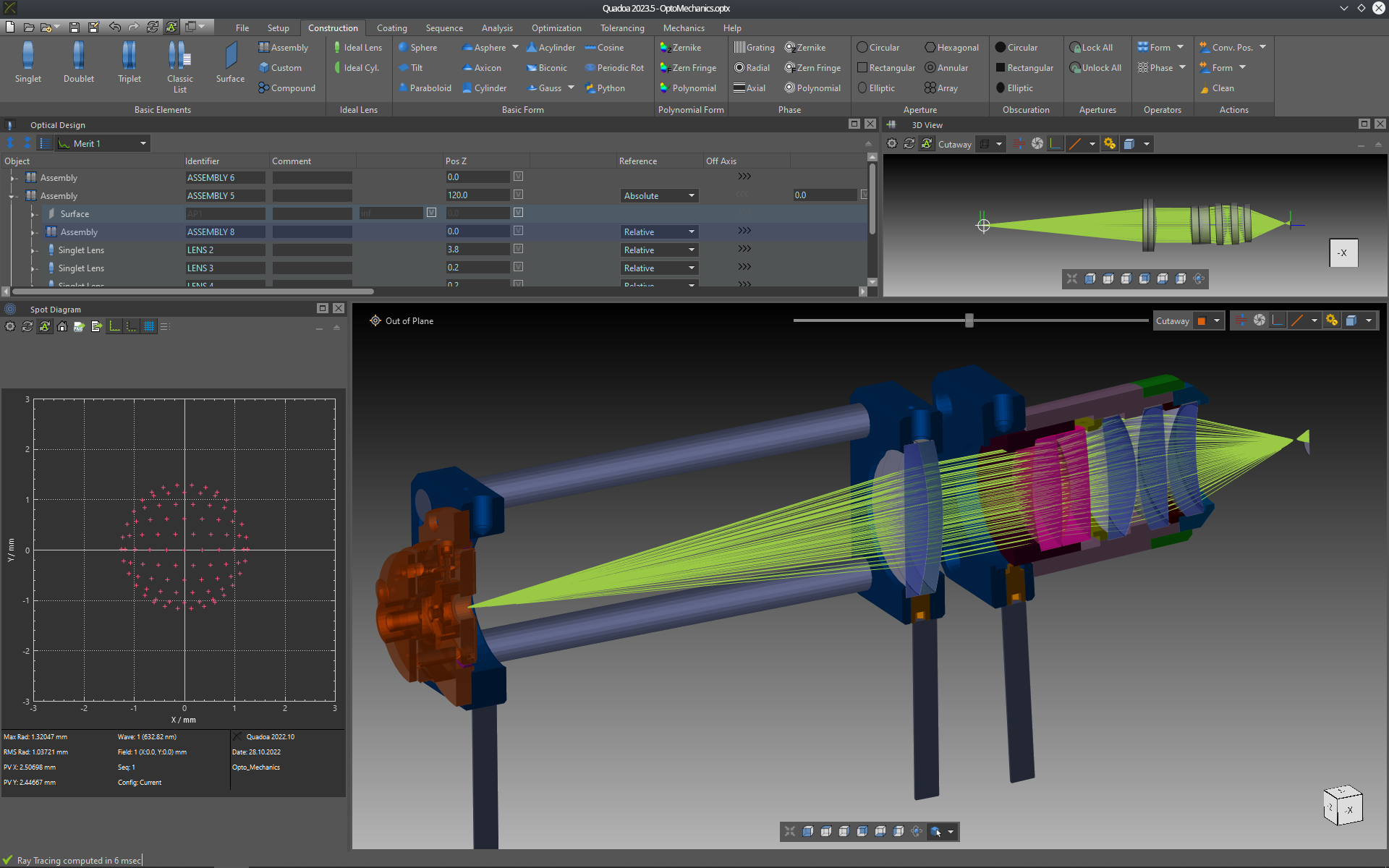
Opto-mechanical lens group mounted on an oscillating pole
For the accurate tolerancing of an optical system besides the optics itself the modeling of the mechanics plays an important role. For example, the mechanics may influence the pivot point of a rotation or affect how lenses inside an assembly tilt and translate individually and as a group. The assembly item in QUADOA® can not only contain optical but also mechanical elements. This enables a straight forward modeling of an opto-mechanical system by directly copying the real-world structure.
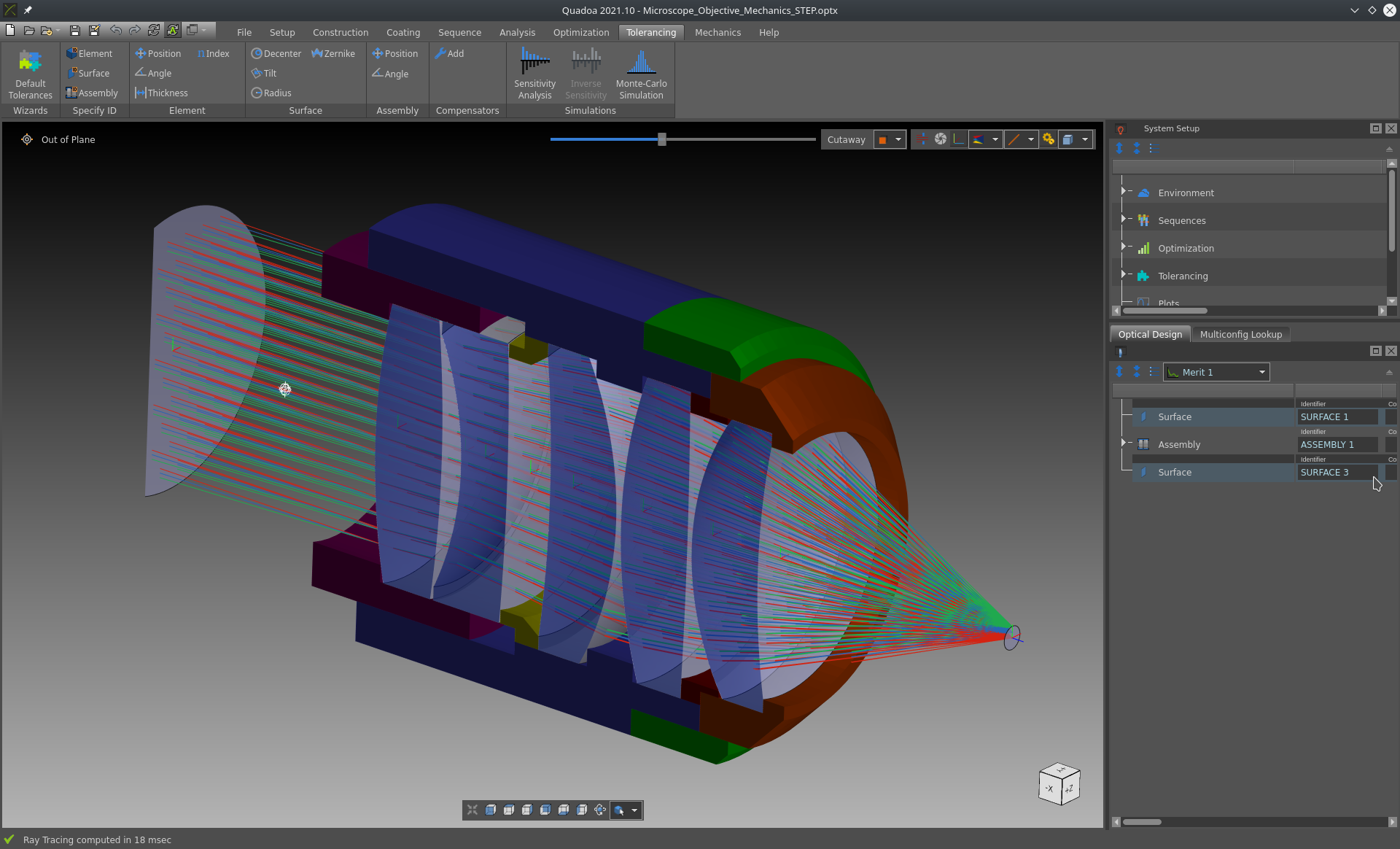
Objective Mounting
Mechanical mounting for a lens imported into QUADOA® to check for any unintended ray-mechanics intersections.
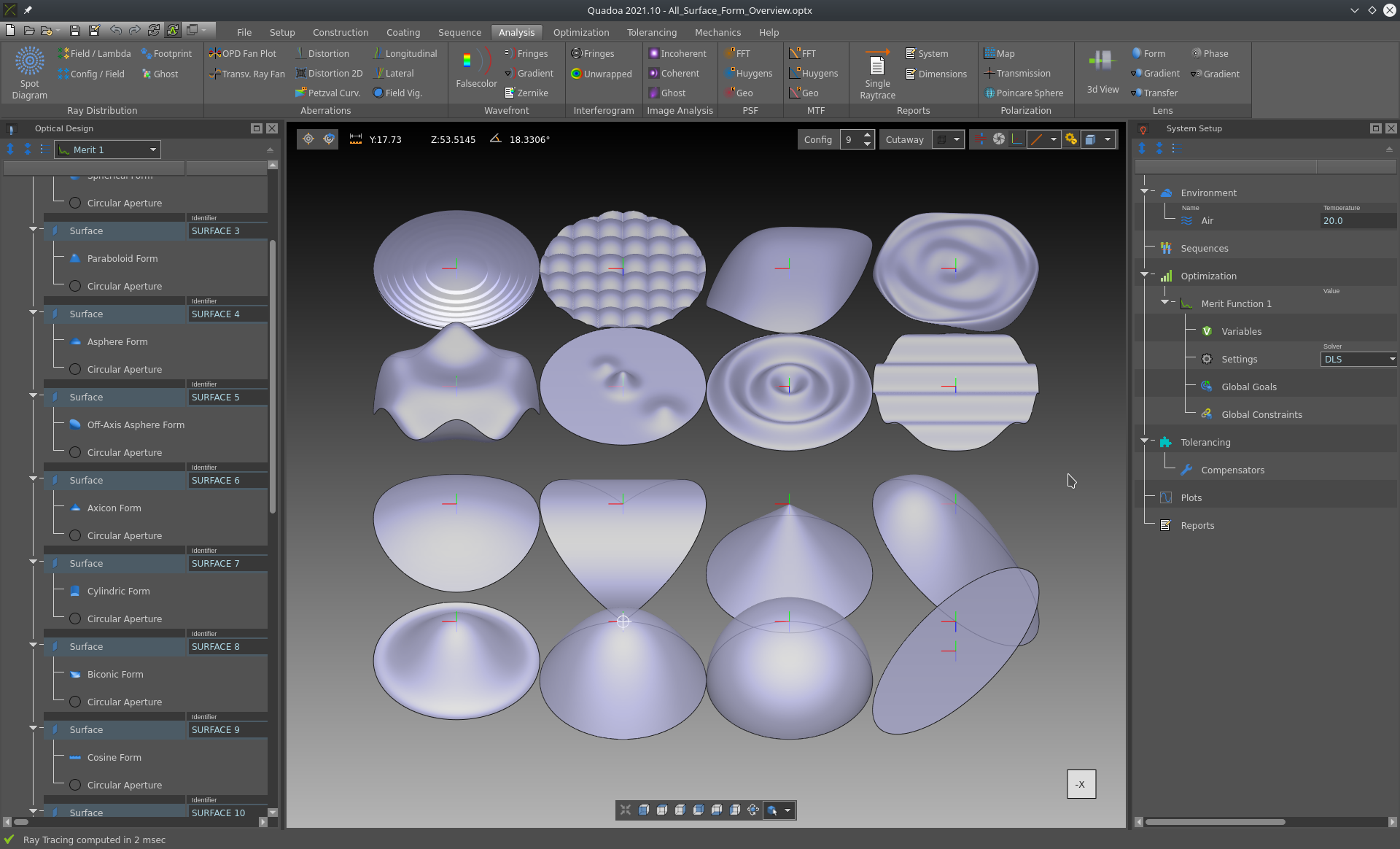
Surface Form Stack Ability
Showcase of a selection of some basic surface form types that can be combined to generate a wide range of surfaces.
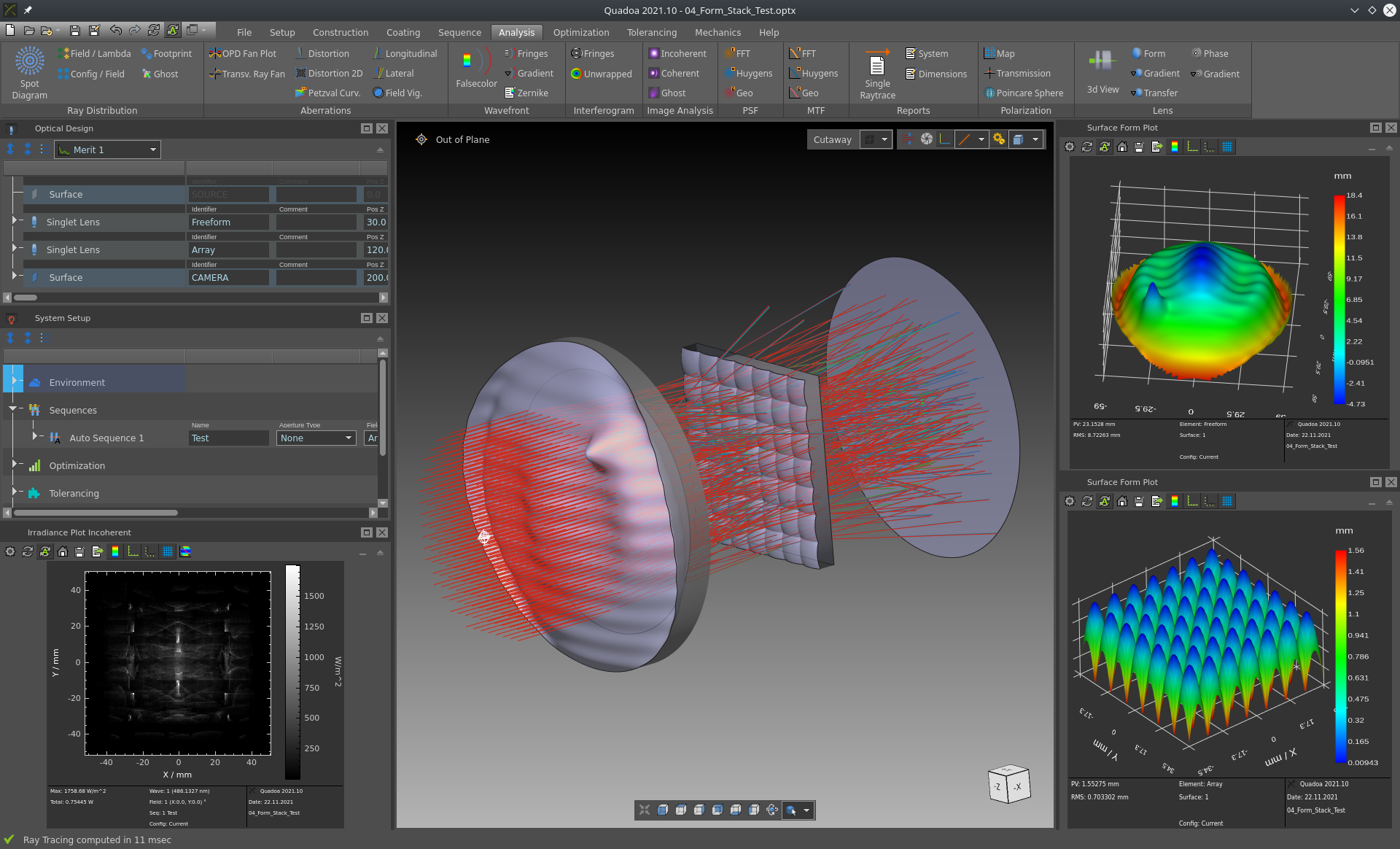
Surface Form Stack Ability: Combined Surface Types
Model to showcase the wide range of possible surface type combinations by stacking of surface shapes and properties.
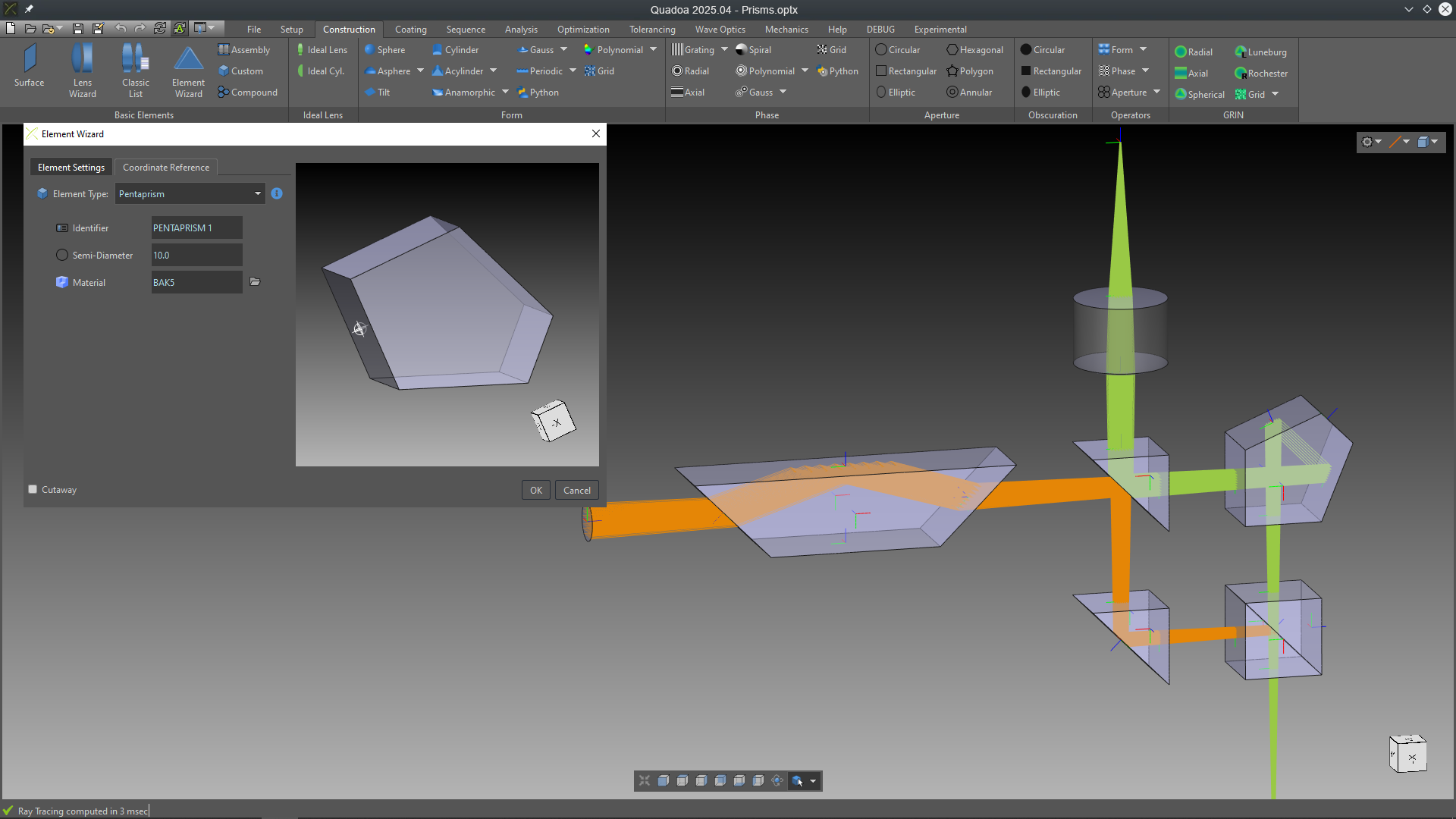
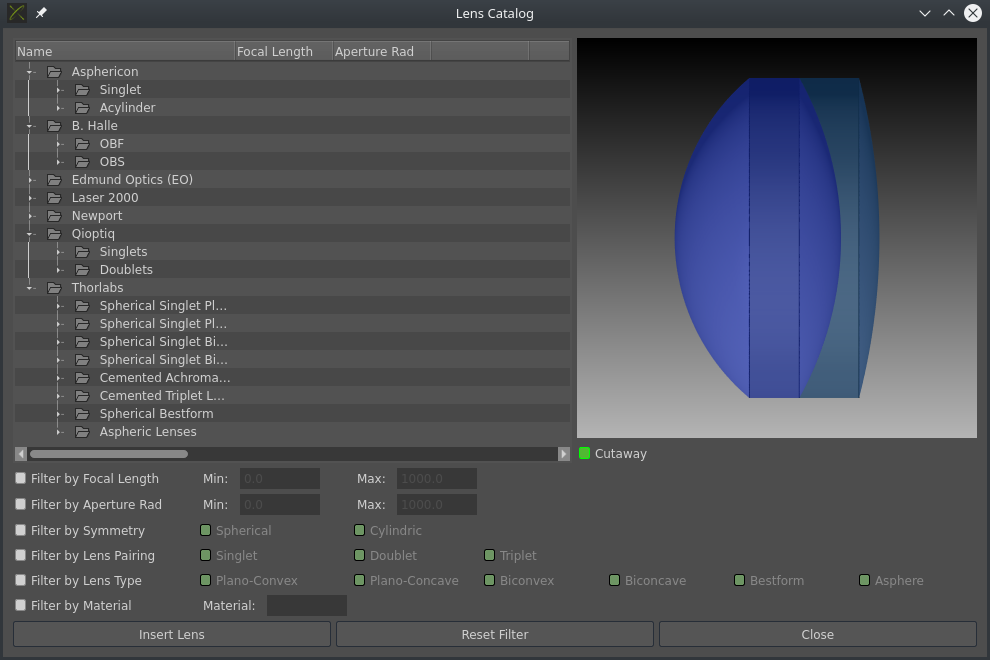
Lens Catalog
The lens catalog included in QUADOA® provides a wide range of stock lenses available from the most common manufacturers.
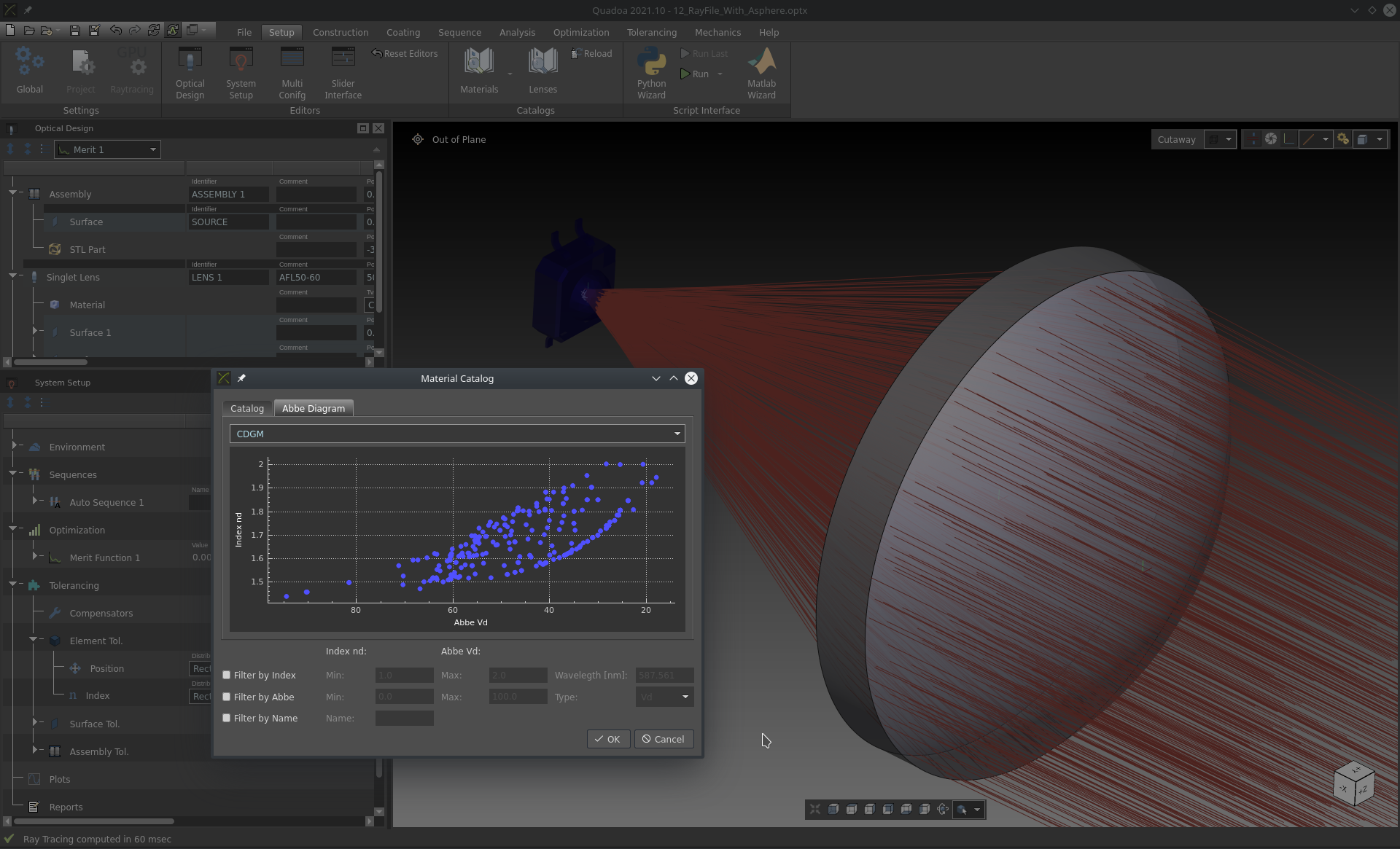
Material Catalog with Abbe Diagram
The material catalog included in QUADOA® includes data of any common glass types as well as polymers that are typically used for optical components.
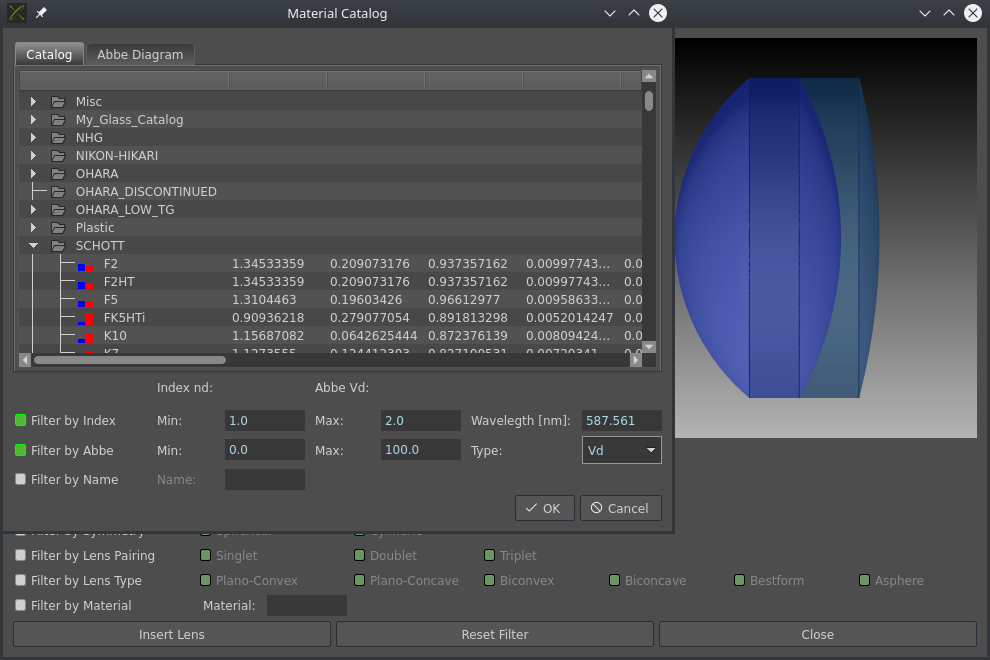
Material Catalog
The material catalog included in QUADOA® includes data of any common glass types as well as polymers that are typically used for optical components.
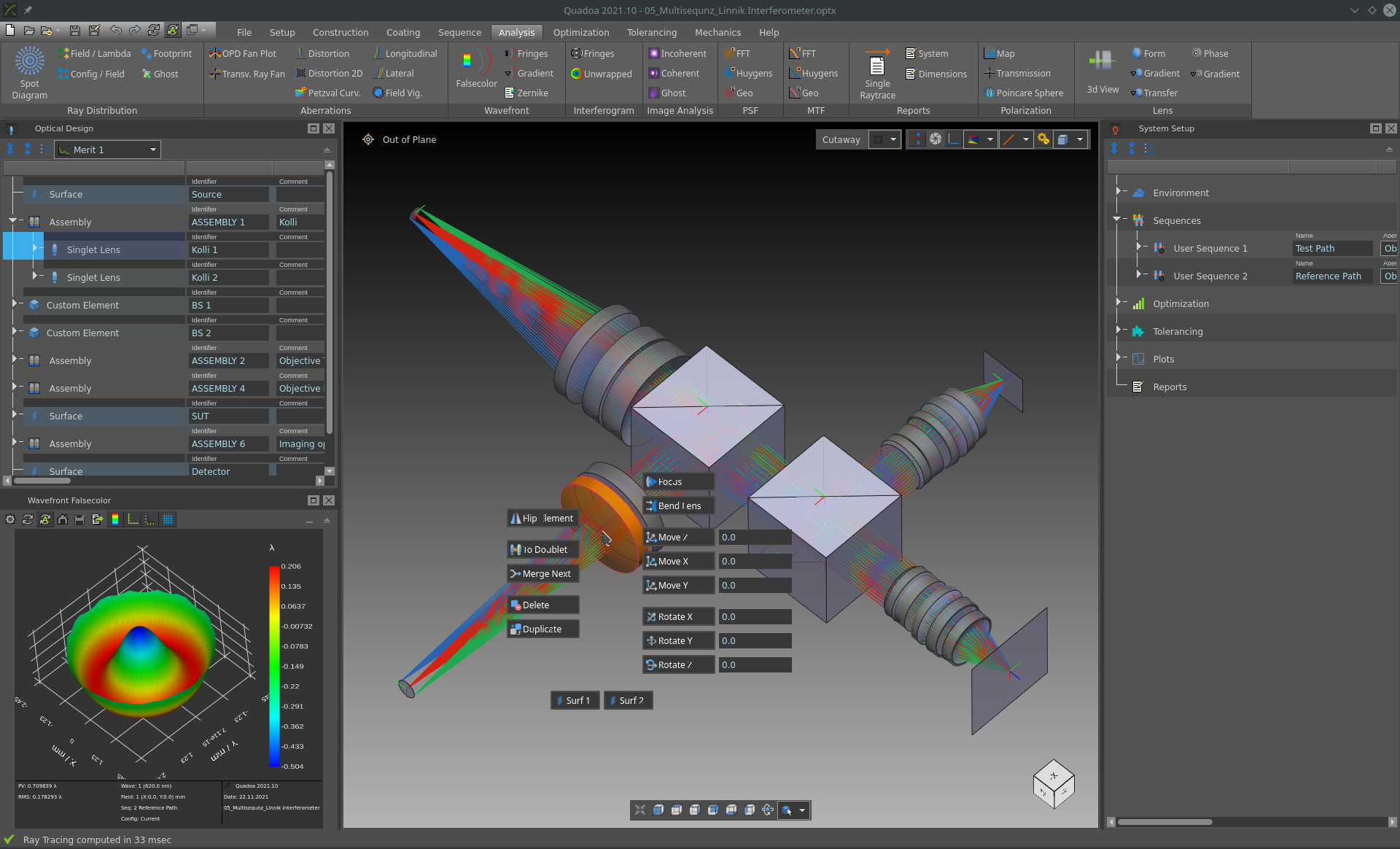
Interactive 3D Menu
The right click menu inside the 3D-View can be used to interactively edit, position, flip or move lenses.
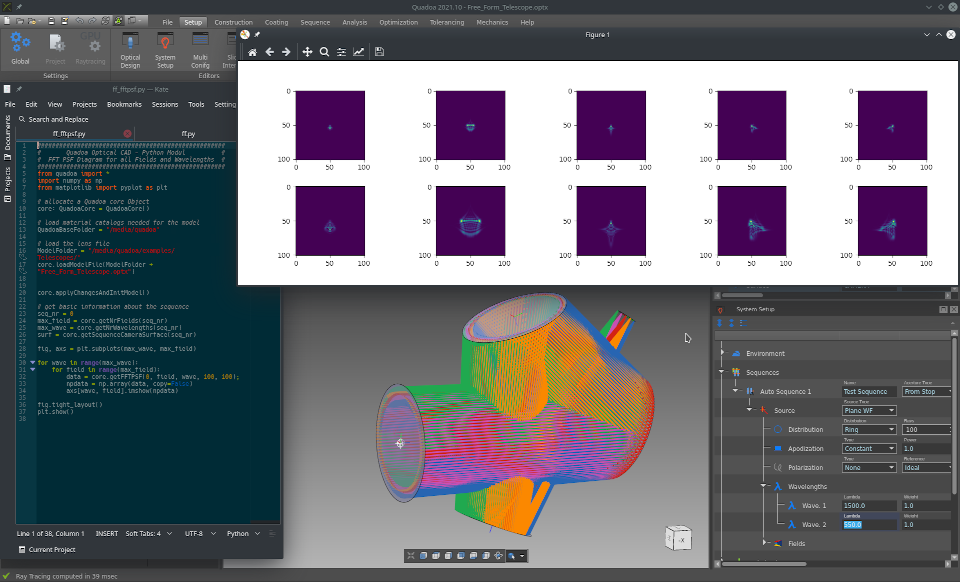
Python Interface
Python script to calculate and plot the point spread function of a lens for a large set of parameters.
Looking for a specific capability? The Features page describes all main features of QUADOA® Optical CAD and includes the complete feature list.