QUADOA® FAQQUADOA® Optical CAD's FAQ provides detailed answers to common questions about the software's features, usage, and troubleshooting.
No. The license quote request is not a binding sales agreement and without any obligation and therefore without any incurring costs for you. After the submission of a license quote request, we will send you a non-binding offer via mail with further license information. There are no costs and obligations for you.
There are no annual costs as long as you buy a perpetual license. QUADOA® Optical CAD is available as a perpetual license without any annual costs, and as a subscription license on an annual basis. After the purchase of a perpetual license, it has no expiration date. You can use QUADOA® Optical CAD for as long as you want at no additional cost. Subscription licenses are available on an annual rental basis.
QUADOA® Optical CAD is sold as a perpetual license without any recurring annual costs and as a subscription license on an annual basis. Once a perpetual license of QUADOA® Optical CAD is purchased, it can be used for as long as desired without expiring. Subscription licenses are offered on an annual rental basis.
Following protection types are available to secure QUADOA® Optical CAD against unauthorized usage.
Hardware-based
Hardware key: In this case, QUADOA® Optical CAD is unlocked by connecting an USB dongle containing the license key to the computer. A commercially available USB port must be present and permanently available on the computer used. Restrictions regarding the required standard of the USB version may result from the Agreement. If a hardware key is used, QUADOA® Optical CAD can be migrated independently to a new computer if the technical requirements are met on this computer.
Hardware-based (network version)
Hardware key (network version): In this case, QUADOA® Optical CAD is unlocked by connecting an USB dongle containing the license key to the network server. The license key is provided within the network by connecting the USB dongle to the network server, which allows QUADOA® Optical CAD to be opened on computers connected to the network server. Since the licenses are concurrent licenses, QUADOA® Optical CAD can be opened on one (1) computer at a time per purchased license. The computers must be permanently connected to the functional network in order to use QUADOA® Optical CAD.
Software-based
Software Key: In this case, QUADOA® Optical CAD is unlocked by reading in an encrypted license key into the computer. When the license key is read in, the license key is installed on the computer, which allows QUADOA® Optical CAD to be opened on this computer.
Software-based (network version)
Software key (network version): In this case, QUADOA® Optical CAD is unlocked by reading in an encrypted license key into the network server. When the license key is read, the license key is installed on the network server, which allows QUADOA® Optical CAD to be opened on computers that are connected to the network server. Since the licenses are concurrent licenses, QUADOA® Optical CAD can be opened on one (1) computer at a time per purchased license.
A QUADOA® Optical CAD cloud license gives you access to QUADOA® from any PC in the world that has internet access. In addition, the QUADOA® license can be shared with your colleagues, even if they are working on a different continent. If you own more than one cloud license, it is possible to have simultaneous access to QUADOA®. QUADOA® is installed on your local PC as usual, and all data is stored locally. Only the QUADOA® license key is stored on a cloud server.
The Software & Maintenance Support is included in the license price for the first year. After the first year, the service can be extended at an annual fee of 25% of the current license purchase price. For subscription licenses, Software & Maintenance Support is included for the entire term of the subscription.
For the first year, Software & Maintenance Support is included in the license purchase price. From the second year onward, the service can be extended for an additional 25% of the current license purchase price per year. This ensures continued access to regular updates for the base version and all purchased tool packages, keeping your QUADOA® Optical CAD installation up to date with the latest features.The Software & Maintenance Support service also includes free email support at support [at] quadoa.com for all technical and operational questions related to QUADOA® Optical CAD. We are committed to providing the best possible assistance to ensure a smooth user experience and to support your success in optical design tasks. Please note that general optical design consulting is not included in this service.
The Software & Maintenance Support includes free updates for the basic version of QUADOA® Optical CAD as well as the purchased toolboxes. Updates are released at least three times a year. The Software & Maintenance Support service includes free advice via email at support [at] quadoa.com for all technical issues as well as operating questions regarding QUADOA® Optical CAD. We are eager to help you in the best possible way to ensure the best user experience with QUADOA® Optical CAD and to support your optical design tasks. Issues regarding general optical design are not included in this service.
Yes! The Free 45 Day Trial is completely free of charge with no incurred costs. It is valid for 45 days and will be automatically deactivated after this period, without the need to unsubscribe and without any additional charges.
The Free 45 Day Trial is functionally limited; for example, saving and access to the Python, MATLAB® and C++ SDK interfaces are disabled.
University research institutions can acquire the QUADOA® Optical CAD university research license. The research must be carried out and conducted on-site at the university and must be funded by the university. If QUADOA® Optical CAD is used as part of an educational course for teaching purposes, you are eligible for an education and research license.
The QUADOA® Optical CAD research license for universities gives researchers access to a modern optical design tool. The research license is not subject to any restrictions regarding publications and patent applications. The research must be carried out and conducted on-site at the university and must be funded by the university. If the research is funded by third-party industry funds, a commercial QUADOA® Optical CAD license is required.
Only university research institutions are eligible to acquire a QUADOA® Optical CAD university research license. Private companies must acquire a commercial license for research purposes.
QUADOA® is committed to supporting scientific and research institutions by providing cost-effective and accessible modern software tools. The research and education license of QUADOA® Optical CAD enables students and scientists to access state-of-the-art optical design software at an affordable rate. In doing so, QUADOA® supports high-quality education and advances scientific research through powerful optical design capabilities.
A QUADOA® Optical CAD network license that contains the network module allows QUADOA® to be used without a personal USB dongle connected to the computer, provided the system is connected to an internal network server. To use QUADOA® with a network license, a network dongle must be connected to the license server, or the license must be installed directly on the server. Depending on the number of licenses purchased, one or more users connected to the same internal network can use QUADOA® simultaneously.
QUADOA® Optical CAD is also compatible with Linux (except the MATLAB® and C++ interface). We recommend testing the free 45 Day Trial on your operating system before making a purchase.
To update or upgrade your QUADOA® license, please send the *.c2v file of your QUADOA® license to sales [at] quadoa.com. You can refer to the Update & Activation License Guide available in the QUADOA® Download Center
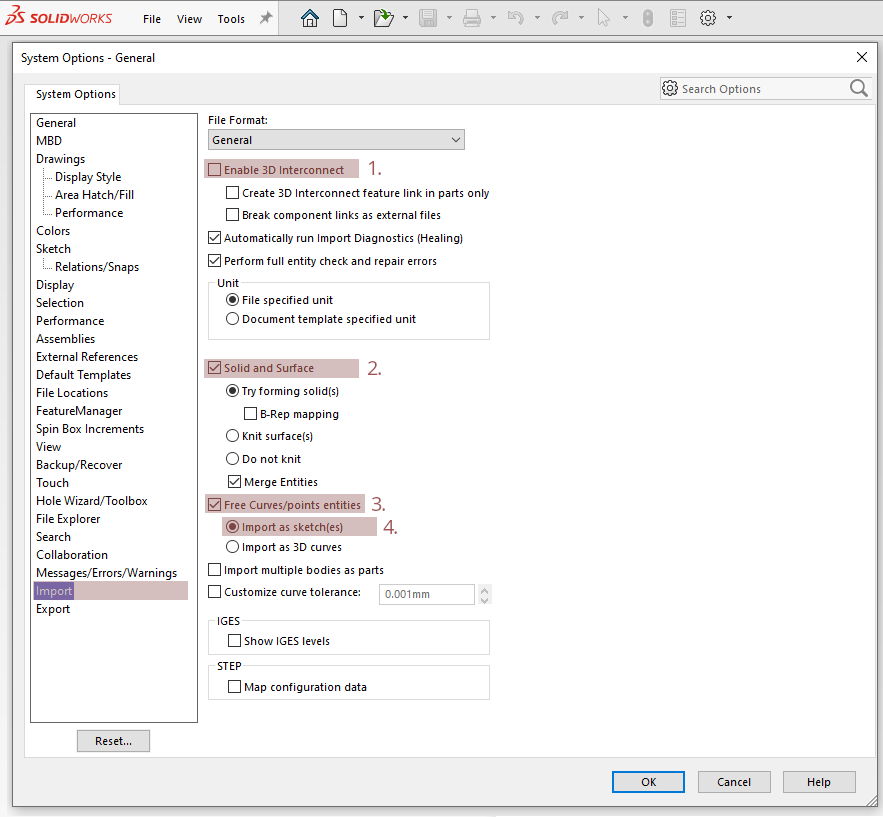
Some mechanical CAD software packages do not display rays when importing an optical design from QUADOA® via STEP export. Below are instructions on how to resolve this issue for different mechanical CAD systems.
SOLIDWORKS®
Change following import settings in SOLIDWORKS® in order to activate the ray-import out of STEP or IGES files.
Fusion 360 and other mechanical CAD software
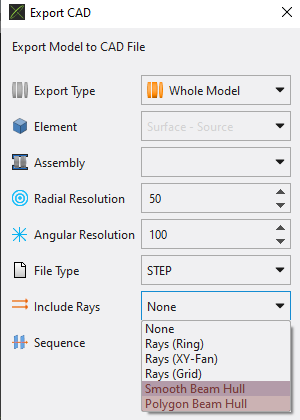
Currently, Fusion 360 and other mechanical CAD software only support the import of surfaces and solid bodies. Curve data from STEP or IGES files is not supported. To resolve this issue, export the rays from QUADOA® as a "Smooth Beam Hull" or "Polygon Beam Hull".
You can find the Key ID in QUADOA® under Setup → License Manager, or in the Sentinel Admin Control Center under "Sentinel Keys".
A black box file is an encrypted file format that allows a proprietary optical design to be securely shared with a customer or partner company. It can then be used to simulate the lens within a larger optical system without exposing the underlying design details.To achieve this balance - protecting the optical design while still enabling ray tracing through it - the required decryption mechanism is typically integrated into the software environment that handles black box files.While it may be technically possible for individuals with advanced technical expertise to extract such protected keys, this is not permitted under German law (§ 202a StGB) and corresponding European regulations (see DIRECTIVE 2013/40/EU OF THE EUROPEAN PARLIAMENT AND OF THE COUNCIL).As a result of these legal requirements, QUADOA® is unable to provide import functionality for third-party black box files.
Port settingsThe Sentinel LDK communicates via TCP and UDP on port 80 and/or 1947. The socket 1947 is IANA-registered specifically for this purpose. It is required that either port 80 and/or 1947 is not blocked in your network settings. Ensure that your network and firewall settings do not block port 80 and/or 1947. If blocked, open these ports in your router and firewall settings to allow proper communication.Proxy server settings If the end-user computer is operating within a company network that uses a proxy server, the proxy server settings must be configured in the Sentinel Admin Control Center to ensure proper communication with the license server. Without correct proxy configuration, the license client may be unable to reach the server, resulting in license retrieval failures. Please ensure that the proxy address, port, and any required authentication details are entered in the Sentinel Admin Control Center under the Network settings tab before attempting to activate or use the license.
If the error message "Feature has expired (H0041)" pops up, the QUADOA® license key could not be found or is not valid for the QUADOA® version you are trying to run. Please check if the QUADOA® Sentinel USB-Dongle is connected to your machine or to the network server. For software licenses, please check if you have an active license key under http://localhost:1947/ Features. If you don't have access to http://localhost:1947/ you may need to install the Sentinel HASP/LDK Runtime driver for Sentinel Dongles from the QUADOA® Download Center
QUADOA® supports a maximum of three concurrent users. If the error message “Too many concurrent users (H0038)” appears when starting QUADOA®, the maximum number of concurrent licenses has been reached.Please note: After an unexpected software crash, this error may also occur due to an improper license release by the Sentinel License Manager. To resolve this issue, place the “Sentinel External License Manager” (hasp_rt.exe) in the same directory as the application that crashed. If the crash occurred in a Python or MATLAB® scripting interface, the hasp_rt.exe file must be placed in the respective Python and/or MATLAB® installation directory.The Sentinel External License Manager can be downloaded from the QUADOA® Download Center.
If the USB dongle is connected via a docking station or USB hub, it may be recognized as different devices and become blocked. To avoid this issue, connect the dongle directly to a USB port on the computer.
If the error message “V2C unknown HASP API 42 ERROR” appears, the Sentinel HASP/LDK runtime is either outdated or not installed. If you have already installed the Sentinel HASP/LDK Windows GUI Runtime Installer, please update it to the latest version. The required runtime driver for Sentinel dongles is available in the QUADOA® Download Center.
If the error message “Feature could not be found” appears—for example when starting QUADOA® or the QUADOA® Mechanics Toolbox—the Sentinel HASP/LDK runtime is either outdated or not installed. If you have already installed the Sentinel HASP/LDK Windows GUI Runtime Installer, please update it to the latest version. The required runtime driver for Sentinel dongles is available in the QUADOA® Download Center
If the error message “Vendor library cannot be found” appears, the QUADOA® Vendor Library required for your QUADOA® Optical CAD license is not available on the computer. To resolve this issue, please install the QUADOA® Vendor Library for software-protected licenses on your PC. The required files can be downloaded from the QUADOA® Download Center.
If the error message “Sentinel License Manager version too old (H0042)” appears after installing QUADOA®, the Sentinel HASP/LDK Windows GUI Runtime Installer is either missing or outdated. Please install or update it to the latest version. The required files can be downloaded from the QUADOA® Download Center.
After installing QUADOA® on Linux, the following error message may appear: "Could not load the Qt platform plugin "xcb" in "" even though it was found.":
This application failed to start because no Qt platform plugin could be initialized. Reinstalling the application may fix this problem.
Available platform plugins are: xcb.
Solution:
in terminal
$ export QT_DEBUG_PLUGINS=1
$ ./AppRun
Check output which library is missing: Cannot load library...