
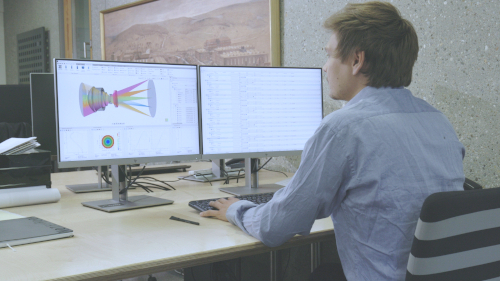


QUADOA Optical CAD Training
Overview
QUADOA offers flexible training: a compact online training in blocks of three hours, and a two-day on-site seminar in Jena, Germany. Both take you from the first system set-up to optimization, ghost analysis and tolerancing.
For customers in the United States, the training is also available through our US distributor Dyoptr, combining QUADOA training with local support.
ONLINE TRAINING
QUADOA Optical CAD Online Training
- Four blocks of 3 hours each
- 1 - 5 participants
- QUADOA license provided
- Price on request
Open a block to see its topics and outcome.
- Get-to-know the interface
- Basic system set-up (lenses)
- Sequence definition (autosequences)
- Performance analysis
- Basic optimization
Outcome: User is familiar with the software interface and is able to design a simple objective.
- User-defined sequences
- Multi-configurational set-up
- Use of parameters
- Math expressions in merit function
Outcome: User is able to set-up and optimize systems of increased complexity.
- Creation of the ghost sequences
- Analysis of ghost reflections
- Optimization of ghost reflections
- Monte-Carlo simulation
Outcome: User is able to manipulate the ghost reflections in the optical system.
- Tolerances definition
- Sensitivity analysis
- Adjustment procedure simulation
- Monte-Carlo simulation
Outcome: User is able to assess the manufacturability of an optical system.
ON-SITE TRAINING
QUADOA On-Site Training Seminar
- 2 days in Jena, Germany
- Led by experienced optical designers
- Your own topics and designs can be reviewed
- From the first set-up to tolerancing and STEP export
The 2-day training seminar offers an introduction to optics development with QUADOA Optical CAD. Step by step, participants familiarize themselves with the features and functions of the software. Open a day to see the agenda.
- System set-up: Shapes (components and surfaces), 3D set-up, materials and catalogs, sequence definition, source definition
- Analysis: Spot, aberrations, MTF
- Optimization: Basic optimization (EFFL, WFE, etc.), basic math expressions (e.g. thickness constraints)
- System set-up: Multi-configurational set-up, coating definition
- Analysis: Ghosts
- Optimization: Multi-sequence / multi-configuration optimization, handling ghosts
- Sensitivity analysis: Tolerance table set-up, compensator definition, sensitivity analysis menu and output
- Tolerancing: MC simulation menu and output
- Mechanics: STEP import / export
Instructors

Dr. Tim Baldsiefen
Tim Baldsiefen has more than 13 years of optical design and engineering experience with optical systems in the areas of lithography, imaging, and laser and material processing. He has held several leading positions in optical engineering in the industry, such as head of optical design at JENOPTIK Optical Systems GmbH.

Kseniia Zavatskaia
Kseniia Zavatskaia has 6 years of optical design and engineering experience in the areas of security and surveillance, interferometry, imaging and biomedical sensing. Besides her design expertise, she has broad experience in lens adjustment and quality control in manufacturing.
The training is conducted by Photonics Precision Engineering GmbH.
Audience and location
The training is dedicated primarily to an audience working in the optical industry. Besides optical engineers, it is also of interest for mechanical engineers working in the optical industry. Participants should already have a basic or advanced knowledge of optics and optical design concepts.
The on-site seminar takes place in Jena, the center of the German optics and photonics industry.